Duke University's inaction on campus land echoes history of housing neglect
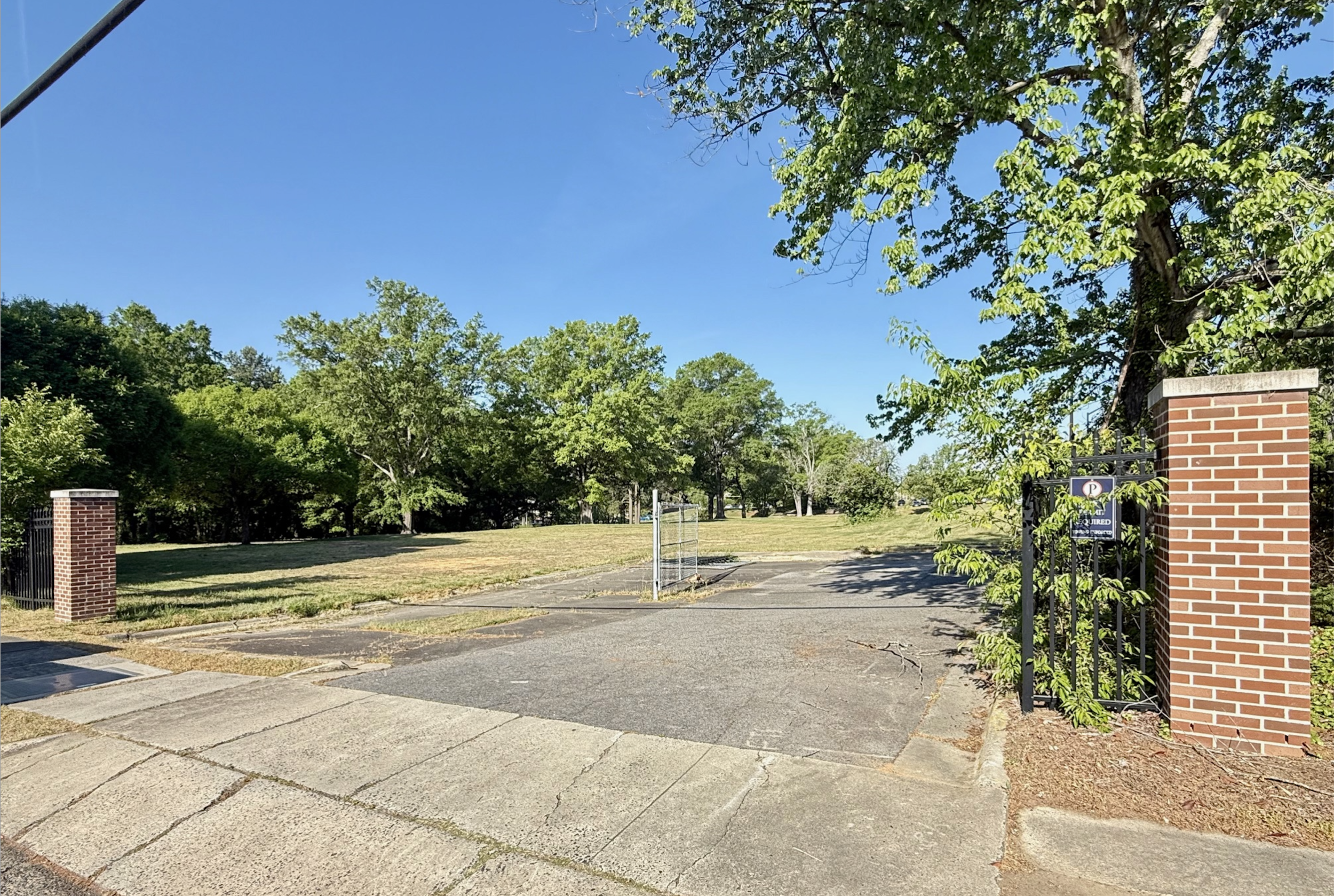
Since student housing on Central Campus was demolished in 2019, the 60-acre site owned by Duke University has been left undeveloped. (Photo: Chris Kromm)
In April of 2024, Duke University filed to rezone ten parcels of its Central Campus, 60 acres of land that bridge the gap between its more densely populated East and West Campuses. The application sparked hope in the community that Duke, the largest landowner and employer in Durham County, NC, finally had a plan for this prime slice of real estate, left largely vacant since the school demolished the last of its student housing in 2019.
But today, Central Campus remains undeveloped, and the university has yet to outline a plan for the land — a lack of initiative that troubles some Durham city leaders and community advocates, especially amid a growing shortage of affordable housing in the area.
The concerns over Duke’s handling of Central Campus are not new. The area has been a point of contention since the university purchased the land in the 1960s, and this latest round of inaction comes at a time when community advocates are putting pressure on Duke to make greater investments in Durham.
The destruction of Erwin Mills village
In 1964, Duke bought most of the property that now makes up Central Campus from Erwin Mills, which had used it primarily for mill worker housing. At the time the university had no concrete plans for the land and considered options as diverse as faculty housing, parking lots, or a recreation area.
Fifty of the around 200 homes that housed Erwin Mills workers were torn down immediately following the purchase to clear the ground for what would become Duke’s Central Campus Apartments. According to ACT, a local organization advocating for Duke tenants at the time, the destruction of the mill houses had exacerbated a severe affordable housing shortage in the city.
ACT also claimed that the remaining houses owned by Duke were in “sub-standard condition,” and Duke refused to make repairs that would bring those houses up to the standards of the Durham Housing Code without shifting the expense to renters, or to aid evicted residents in finding new housing — citing the same housing shortage that ACT claimed Duke itself had contributed to.
“Duke is part of Durham, but it makes decisions in its own institutional interest without caring about the effect on Durham’s people.” wrote Ninian Beall, a Duke graduate and ACT organizer.
Ultimately, Duke let the Erwin Mills houses fall into further disrepair. According to John Schelp, a historian and former president of the Old West Durham Neighborhood Association, the university cited defects in the houses in order to have them condemned by the city, paving the way for further demolitions throughout the 1970s.
The rise and fall of Central Campus apartments
By 1975, the university had completed the construction of its Central Campus Apartments, built to house Duke students. Throughout their existence, the apartments were plagued by consistent complaints about their conditions, allegedly due to poor maintenance by the university.
Issues with cockroaches necessitated annual insecticide spraying, and mice were a common sight. Bats were also a regular concern, prompting evacuations on at least two occasions. Ceiling holes, water damage, and poor building materials were the subjects of other complaints.
Later students experienced health issues which they attributed to mold caused by infrequent cleaning of ventilation systems. When a leaky pipe caused one student’s apartment ceiling to collapse, her experience with Duke’s response led her to say “The general consensus, I feel, is that they just don’t care.”
The consistently poor condition of the Central Campus Apartments is particularly noteworthy given the high proportion of Black Duke students housed there from the 1980s onward. In 1984, 53% of Black non-freshman undergraduates lived on Central Campus. These numbers stayed relatively steady until 2004, when new policies restricting sophomore housing on Central caused the percentage of Black upperclassmen there to drop from a high in 2000 of 55.8% to 44.2%.
While some attributed the concentration of Black students on Central Campus to cultural differences or its lower cost, others cited the fact that white majority fraternities at Duke long received designated housing in the coveted dormitories on West Campus, up until a major overhaul of Duke’s selective living policies in 2012. Fraternity housing was a constant at Duke until selective living was suspended in the 2020-21 academic year due to the COVID-19 pandemic.
As the poor condition of the Central Campus Apartments made their eventual demolition an inevitability, Duke began to envision a new future for the area. In 2003, the university debuted an ambitious Central Campus “village” proposal which would have included a Main Street with stores, restaurants, and bars, as well as a health club, bowling alley, and even a monorail. An informational packet sent to interested developers and architects described the new Central Campus as a "vital residential neighborhood with a strong, memorable sense of place" that would make the University a "walking campus.”
In 2005, the first phase of the plan, which would have involved the demolition of the Central Campus Apartments and their replacement with new student housing, was delayed until 2008. In 2008 these plans were delayed indefinitely due to the financial crisis, and Duke refocused on maintaining the existing Central Campus apartments instead, with some limited renovations taking place between 2010 and 2013. The apartments limped along, with students reporting myriad health and safety issues until they were finally demolished in 2019.
Inaction and unclear plans
Since the 2019 demolition, Central Campus remained undeveloped, with large swaths of the area left empty fields. A Board of Trustees Task Force assigned to consider the issue in 2018 was unable to outline a plan for the space, determining that there was no “compelling opportunity” to spur development.
Duke’s inaction has drawn the ire of some Durham community members, who believe the land could be used to help address the city’s affordable housing issues. An online petition launched in 2023 calls for Duke to use the land for additional student housing, arguing that the lack of on-campus housing options has caused students to occupy scant affordable housing in the city, pushing out Durham residents and driving up housing prices.
For this reason, Duke’s 2024 submission for rezoning of Central Campus was initially considered to be a welcome development. But their rezoning application contained no clear indication of the university’s plans for the property. In addition, the application fell short of meeting the requirements of the Durham-Chapel Hill-Carrboro Metropolitan Planning Organization’s Comprehensive Transportation Plan and the Durham Unified Ordinance. Most of the compliance issues result from Duke’s failure to meet the Department of Transportation’s request for a public access pedestrian and bike path.
Despite these shortcomings and the lack of concrete plans, the rezoning was approved by the Durham City Council in October 2024 by a 5-2 vote. At the time, City Council member Nate Baker explained his vote against the rezoning: “[University and College zoning] is a privilege. It is a very unique zoning district that allows great latitude to those who own land,” Baker said. “I always seek planning before zoning.”
Nearly two years later there have been no developments on the property.
As for the remaining tenants in the few houses that still dot Central Campus, recent reports suggest that Duke, as a landlord, has taken a similar approach to what it did in the 1960s.
As reported by Indy Week, when Kelly Creedon and the community space she started, The Living Room, became Duke tenants in late 2025, she was informed by the Duke Director of Real Estate, Julie Siegmund, that Duke would not maintain critical elements of the property — including the roof, HVAC, and electrical panels — which would eventually render it uninhabitable for Creedon and other community members making use of the space.
Creedon’s former home, some of the last affordable housing in the area, is currently slated for demolition.
Tags

Lekha Shupeck
Lekha Shupeck is Director of Programs at the Institute for Southern Studies, publisher of Facing South, where she helps oversee programs and strategy. Before joining the Institute, Shupeck held leadership positions at Documented, All On the Line, and the ACLU of North Carolina.