Unions make slight gains in South, mirroring national trends
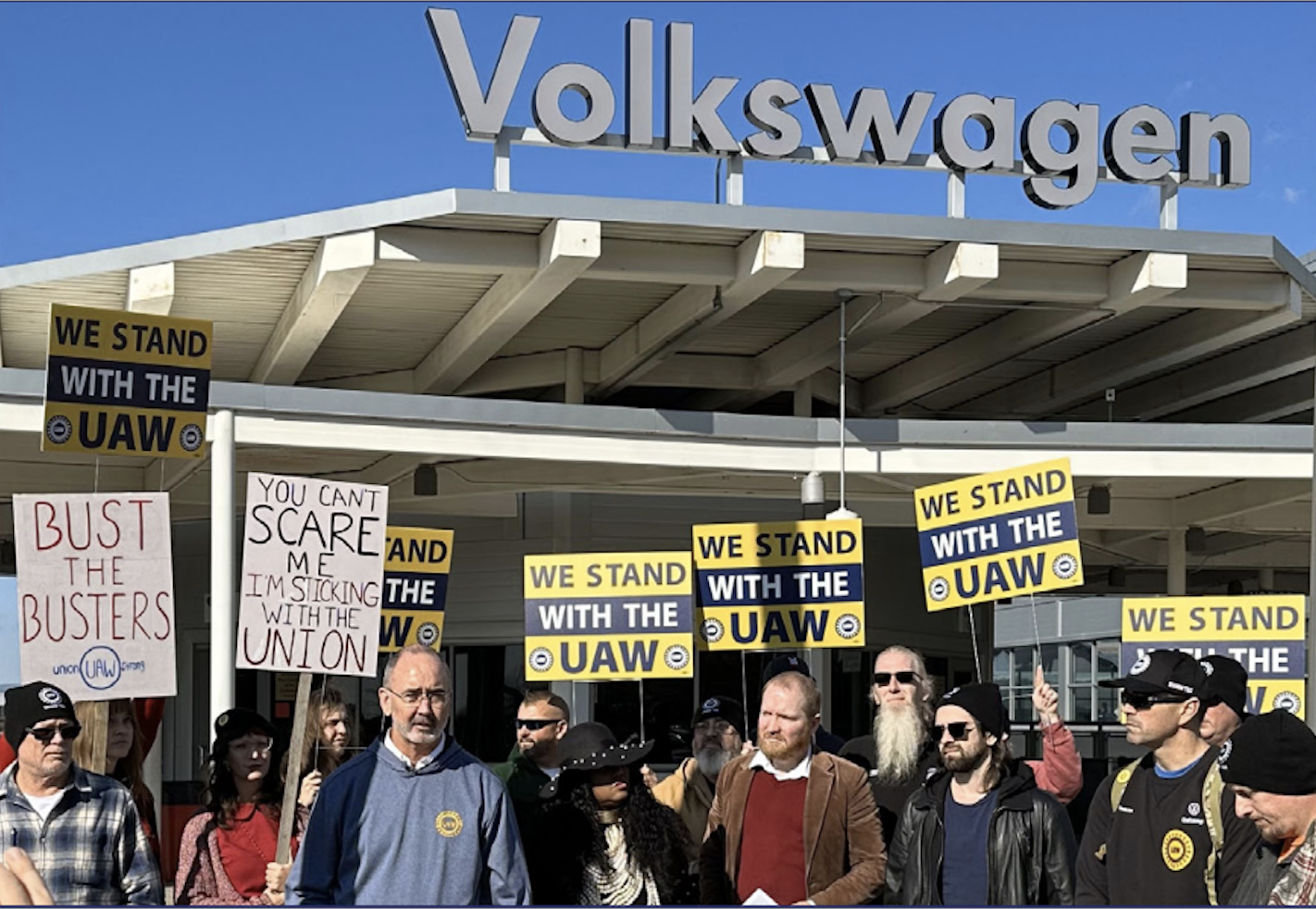
Workers at Volkswagen's plant in Tennessee won union recognition in 2024, but didn't secure a contract until February 2026. (Photo: UAW)
The share of Southern workers in unions slightly increased in 2025, mirroring a small uptick in unionization nationally, according to government data released in February.
The Bureau of Labor Statistics numbers showed that 14.7 million workers belonged to a union in 2025, an increase of 463,000 from 2024 and the highest number of unionized workers in the U.S. since 2009.
Labor unions added 166,000 workers in 13 Southern states, with Georgia registering by far the biggest gains: 62,000 more Georgia employees belonged to a union in 2025 than in 2024. Florida, Louisiana, Texas, and Virginia witnessed small increases, while Kentucky, North Carolina, South Carolina, and Tennessee largely held steady. Alabama, Arkansas, Mississippi, and West Virginia saw declines.
The following chart shows the share of workers in each state that belong to unions, and those that work at jobs with union representation in 2024 and 2025. Use the scroll bar at the bottom to see the full table.
Southern states continue to lag significantly behind the rest of the country in union membership. Close to 4.9% of workers in the South belong to a union, and 5.9% of workers are employed in a workplace that enjoys union representation. That compares to 12.7% union density in the rest of the country, and 14% of non-Southern workers having union representation at their workplace.
Labor’s modest gains come amidst a wide-ranging assault on worker protections under the Trump administration. Since coming into office, Trump has sought to strip collective bargaining rights for more than 1 million federal workers and eviscerated worker health and safety protections.
The government's unionization figures understate the full scope of labor activity in several key ways. For one, it only captures workers who have successfully won a union contract. The data doesn't include, for example, the United Auto Workers' historic union election in 2024 at Volkswagen's plant in Tennessee, where 73% of workers voted in support of unionizing. That's because the union's contract wasn't ratified until February of 2026.
Labor unrest in the form of strikes is also at its highest level in more than two decades. Each year from 2023 to 2025, there were 30 or more work stoppages involving 1,000 or more people. In 2025, that included strikes by Starbucks Workers United employees in six Southern states.
Indeed, many workers would join a union if they had the opportunity. Nationally, support for labor has risen over the last 15 years and stayed strong since the beginning of the pandemic. In 2025, Gallup found 68% of the American public saying they approved of unions, matching the support labor enjoyed during its heyday in the 1960s.
As labor historian and advocate Lane Windham notes, research shows that close to half of all workers say they'd be part of a union if given the chance. "People want to be part of unions," Windham says. "It’s up to unions to figure out how to bring them in."
Tags

Chris Kromm
Chris Kromm is executive director of the Institute for Southern Studies and publisher of the Institute's online magazine, Facing South.