UNITE HERE shakes up NC politics: A conversation with Maria Hernandez
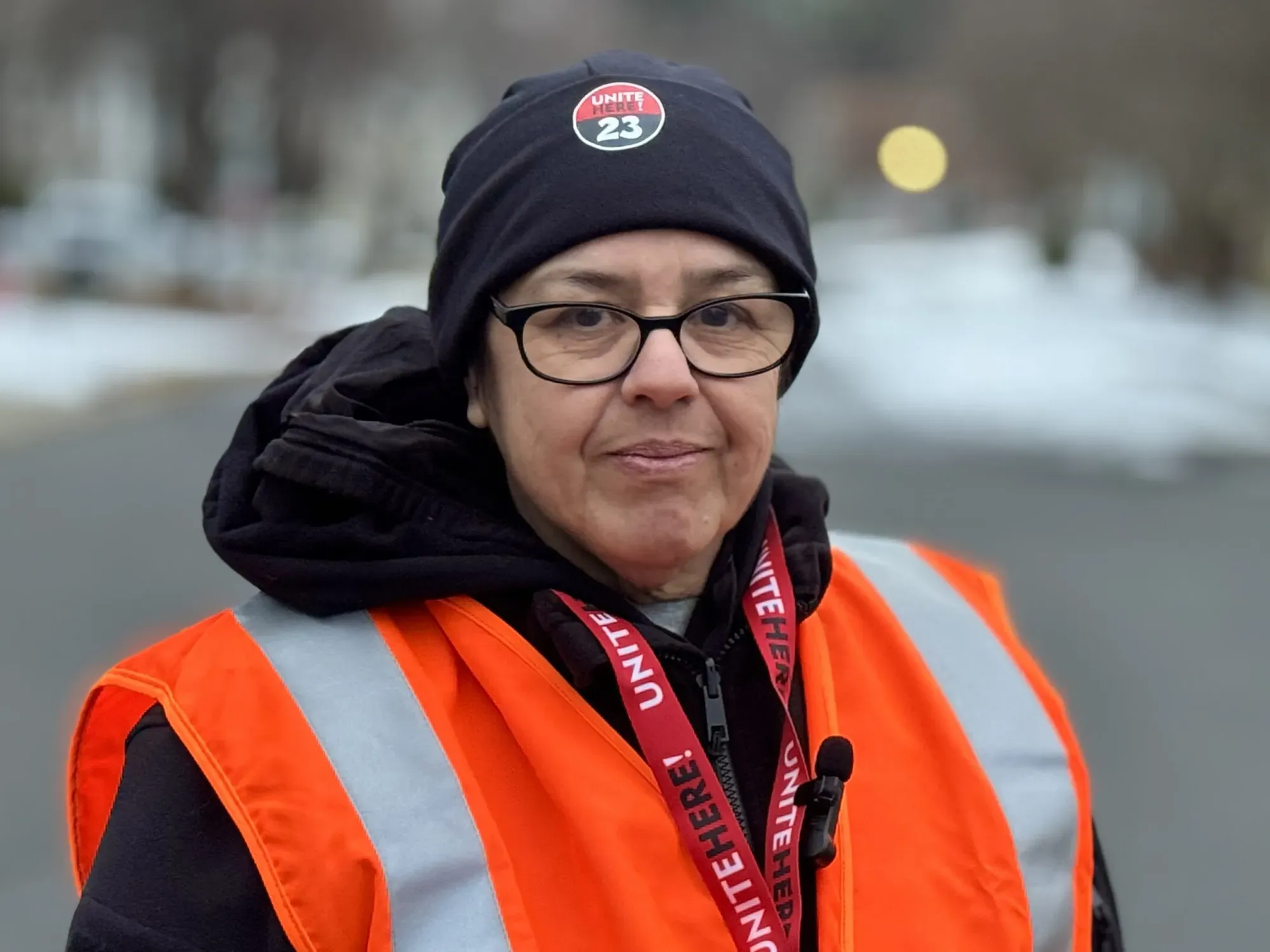
Maria Hernandez, a food service worker at the Charlotte airport and member of UNITE HERE Local 23, was part of of an innovative worker-led organizing effort that successfully unseated three conservative Democrats and replaced them with progressive candidates in North Carolina's March 2026 primary elections. (Photo: UNITE HERE)
This past March, three Democrats in the North Carolina General Assembly who had sided with Republicans on key votes lost their primary elections to progressive challengers. The defeated incumbents included Rep. Carla Cunningham, a Charlotte-area legislator who voted with the Republican majority 84% of the time and helped the GOP overturn 15 vetoes by Democratic Gov. Josh Stein. Cunningham lost to Rev. Rodney Sadler, a progressive minister active in the Moral Monday movement.
Among the groups that mobilized for progressive challengers was the hospitality workers union UNITE HERE, which knocked on 46,000 doors statewide to support Sadler and two other candidates. The 2026 primary effort was part of UNITE HERE’s larger vision for building labor/community coalitions to advance a working-class agenda in North Carolina. Chris Kromm of Facing South talked with Maria Hernandez, a leader of UNITE HERE Local 23 and food service worker at the Charlotte airport, who was deeply involved in the union’s organizing this spring. Today, three generations of her family, including her teenage granddaughter, are involved in the union.
The interview has been lightly edited for clarity and brevity; you can watch the full video on the Facing South/Institute for Southern Studies YouTube channel here.
Could you tell us a little bit about how you got involved with UNITE HERE?
Well I was tired of the attacks on immigrant families and Latino communities. As you know I'm a third-generation U.S. citizen, and both me and my grandson, we always have to carry our passport, ID and birth certificate wherever we go. We've been stopped before where we have to show everything, our whole paperwork and everything. We still have to wait for them supposedly to verify us to make sure that it's our paperwork. That's not the way we should be living, you know, we're U.S. citizens.
Charlotte was in the national news last fall when border patrol swept into town with their aggressive immigration raids. You're a citizen, but I know that many of you and many close to you in your community were deeply impacted by that. What was that like?
Where I live, it's a small community of a couple of streets with Latino families, there's over a thousand families in a mobile park area. There's one way in, one way out. What they did, they had like 20 SUVs parked outside like three or four in the morning. They parked out there and they were waiting for everybody to start coming in and out.
We were trapped inside, even though there were a lot of us that were U.S. citizens. A lot of the people there, they grew up there. They're raising their kids there, they're in their 20s now but they grew up there. Nobody went to school, nobody went to work. We were basically trapped in an area where we should feel free because we're in America, you know we shouldn't live that way. We were trapped there.
[Incumbent Democrat Rep. Carla] Cunningham signed for them to come, you know, to have more immigration come out. You have to live through something like that to know what it feels like.
There were politicians across the aisle that were going along with that, and I'm sure it was one of the reasons why you were inspired to get involved in the political process. What was it like to be part of UNITE HERE as your community was going through that?
It means a lot to be part of the union that is fighting back against the hate and discrimination and the systems that don't want to see us win in life. And to know that I don't have to do it alone has motivated me to keep going.
In addition to representing workers on the job, you and UNITE HERE have taken a lead in getting people involved in the political process. Could you tell me about what you've been doing to reach and educate voters and getting people to participate?
In addition to canvassing for the primary, we've been knocking doors for months talking to union members and hospitality workers in our communities. It really makes a difference when you see your co-workers or neighbors out in the community to keep them informed by educating voters or putting the power back in their hands to be the change they want to see.
[While canvassing] I hit a neighborhood with four or five houses, they were all related. I was talking to them and they're U.S. citizens. And they were telling me that they were not going to go vote. And I asked them why they didn't want to vote. One of them told me, “I was chased from Lowe's, they chased me home and they were threatening me”. And I told him, “That's why you should vote.”
I said, “I promise you, if you guys go vote and you bring your friends to vote, a lot of us union representatives are going to be at the polls. We're going to be there to support you guys and no one's going to bother you guys … If there's ICE there, there's going to be more of us union people there.” So, you know, he goes, “Well, we'll think about it.”
We had cars drive by, just testing to see if union members were there at the polls. And every time they would drive by, we would wave at them; we were wearing bright orange vests. So I was at one of the polls, and lo and behold, he shows up. And he looks at me, smiles, and he goes, “Mari!” and I go, “Told you I'd be waiting for you.” And a while later, his family started showing up to vote. And he gave me a hug, and I took a picture with him.
Your presence was so important to breaking that climate of fear. How do you inspire people to make that call that it's worth going out and taking a stand like that?
While our stories are super powerful, when you meet someone you can hardly tell anything about who they are or where they're from based on appearance alone. Having conversations is when we learn from each other. What makes us different, what brings us together. As a Latina woman and union member who lives and works in Charlotte, telling my story is how I connected with the voters. It's how we connect with each other every day.
Could you tell me a little bit about how you got involved in the union?
It goes back a couple of years, when Trump first took office. My grandkids — they're in the union now, they're in their 20s — they were kids, they were small. There was a raid in front of their school. The border patrol, you know, ICE was parked in front of the school.
And whenever I tell the story, I cry because as little kids, they shouldn't go through that, because they live with it for the rest of their lives.
They were being dropped off at school and as their parents were coming out of the parking lot they were being arrested in front of their kids. I mean these are little kids and they're watching their parents being taken away. And instead of having a good day in school they're watching their whole day being ruined, their whole lives being ruined. And my grandkids — I have custody of them — were watching all this going on.
And imagine you seeing all this going on … and they don't know if I'm going to be home when they get home. And when I get home and I'm waiting for them, they see me, that I'm there, and they run up and hug me. The expression on their face says a lot. They start telling me about their friends’ parents, that they're not there, and just fear in their eyes.
When we sit down to eat, the little one keeps touching me, because she can't believe that I'm home. I'm a single grandparent, single mother, I'm everything to them. I'm the only family they have. That night we all slept together and I could feel in the middle of the night the little one touching my face, trying to know if she believes or doesn’t believe it that I'm home.
The next day, I can barely afford to put food on the table and I can't go to work because they're so clingy and they're scared that if I go out of the house, I'm Mexican and I won't come home. I spend the whole day missing out on money that we need just to make them understand that I'll be home that day.
The day that happened, the buses were coming into my neighborhood with the teacher, [who had a sign-out sheet] to make sure that there would be parents to receive their kids, or if those kids had to go back to school, to find out you who was going to receive those kids if they didn't have parents. Imagine going through that.
So I made a promise, if I can help — the union’s always helped me, why shouldn't I join the union? So the kids grew up seeing me helping the union. My granddaughter kept telling Aiden [Graham, UNITE HERE’s North Carolina political director], I want to join the union. He kept telling her, you have to wait until you're 18.
The day she turned 18 … He goes, “I guess I have to bring her on if she's 18.” And fair enough, he put her into a group and she went out and knocked on doors.
Wow, so this is a family affair now, being involved in the union. And that kind of solidarity that you and the community feel being part of the union, I mean, that just sounds so powerful.
Three generations.
The program that you helped lead had a lot of success, including helping elect some progressive candidates for the North Carolina General Assembly who will now go on to the general election this fall. What do you feel has made this so successful?
Getting out with my union and being active with the community. The way we do it gives me courage to continue fighting to bring change to North Carolina. The results of the past primary election gave me hope that change is coming. Not only that, seeing the turnout from voters who decided they wanted a change has given me hope too.
But we're going to keep going because the work doesn't stop here. We have to keep going.
Tags

Chris Kromm
Chris Kromm is executive director of the Institute for Southern Studies and publisher of the Institute's online magazine, Facing South.