Trump administration escalates pressure on Southern states for voter data ahead of midterms
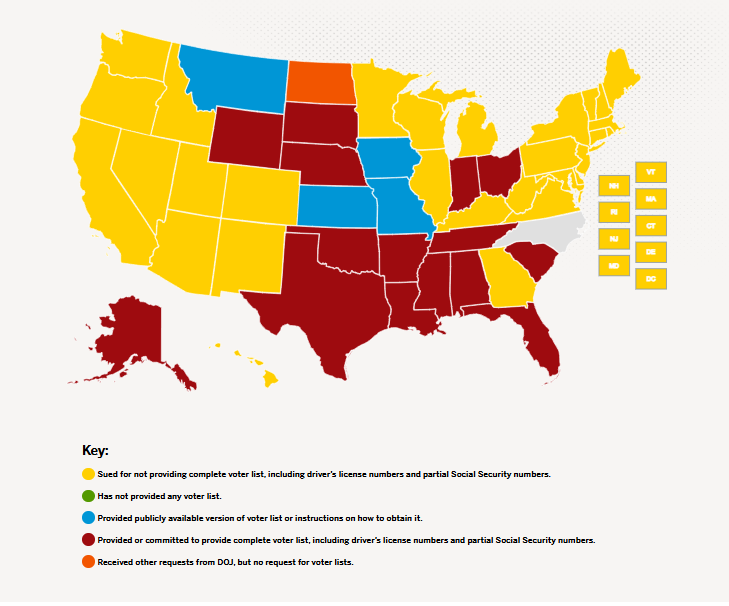
This map from the Brennan Center for Justice shows the requests, states’ responses, and lawsuits related to the Department of Justice’s attempts to acquire voter data across the country ahead of the November midterm elections. (Map courtesy of the Brennan Center for Justice).
As the U.S. prepares for the consequential midterm elections — and the Trump administration intensifies its efforts to reshape how elections are conducted across the country — Southern states find themselves at the center of an unprecedented federal overreach to collect private voter data.
In May 2025, the U.S. Justice Department began demanding that nearly every state and Washington, D.C. turn over election-related records, including complete statewide voter registration lists, ballots from past elections, and access to voting equipment. The requests also include sensitive personal information including partial Social Security numbers and driver's license numbers, raising the alarms for privacy and security concerns.
Voting rights advocates argue that the Trump administration’s demands infringe on the U.S. Constitution, which largely protects the power of states to manage elections and lay the groundwork for federal interference in voting. In response to the federal requests, most states have provided a publicly available version of their voter registration lists , which do not include Social Security numbers and driver’s license numbers; others have refused to comply altogether.
According to the Brennan Center for Justice, which has been following the requests and state responses, the federal government has sued 30 states and the District of Columbia for refusing to provide their statewide voter registration lists with driver’s license and Social Security numbers. To date, eight of those lawsuits have been dismissed. Another court dismissed the suit against Georgia for filing in the wrong jurisdiction; the Justice Department later refiled in the correct district.
This month, the Department of Justice's Office of Legal Counsel released a 41-page legal memo attempting to justify the data collection effort. The May 12th memo acknowledges that election administration is "primarily the purview of the states," but argues that the administration's demands are a legal exercise in federal oversight, based on a section of the 1960 Civil Rights Act that requires election officials to keep voter records for 22 months after an election. It also says this rule allows the Attorney General to request copies of those records in writing. "No state is entitled to withhold responsive materials based on privacy or confidentiality provisions found in state law," the DOJ wrote. The memo also indicates that the Justice Department does not plan to dial back its push for voter data, even after federal judges in California, Oregon, Michigan, Massachusetts, Rhode Island, and Arizona have blocked it from forcing states to share their voter lists.
Of the at least 15 states that have either provided or agreed to provide their full voter files, including sensitive personal information, a majority are in the South: Alabama, Arkansas, Florida, Louisiana, Mississippi, South Carolina, Tennessee, and Texas are among those that have turned over their complete voter rolls. In doing so, several states agreed to a "memorandum of understanding" with the DOJ, in which the DOJ outlined its plans to use the lists to purge voter rolls.
The intentions also grew clearer in March 2026, when the Acting Chief of the Voting Section of DOJ's Civil Rights Division said in a court hearing that the agency plans to run collected voter data against DHS's SAVE database, the Systematic Alien Verification for Entitlements program used to check immigration status. Civil rights attorneys argue that this could lead to unlawful purges of eligible voters, especially naturalized citizens and communities of color.
The voter data push is part of a broader pattern of federal encroachment on election administration. The FBI has also used search warrants and subpoenas to obtain records from the 2020 election in Fulton County, Georgia, and Maricopa County, Arizona. It reportedly also asked for the names of everyone who worked as an election worker in Fulton County during that election.
However, not every Southern state has complied. Republican West Virginia Secretary of State Kris Warner, for example, had made clear the state has no intention of handing over more than what is already publicly available. "West Virginians entrust me with their sensitive personal information. Turning it over to the federal government, which is contrary to State law, will simply not happen," Warner said. "State law is clear: voter lists are available in a redacted format from my office, but I'll not be turning over any West Virginian's protected information."
In addition, the administration’s efforts have faced significant legal pushback. On April 21, 2026, Common Cause and four of its members filed a lawsuit to block the creation of what would effectively become a national voter database and to prevent voter data from being cross referenced with the SAVE program.
"This is a blatant, partisan power grab designed to cast doubt on the validity of our elections and whose vote should be counted," said Virginia Kase Solomón, Common Cause President and CEO. "By attempting to interrogate and exploit voter data for political purposes, President Trump’s DOJ isn’t just threatening the privacy of every American — they are building a system designed to imprison the ballot box and silence millions of eligible voters." That case is currently ongoing.
With midterm elections quickly approaching, voting rights groups say the administration’s effort to create a national voter database connected to immigration enforcement could lead to voters being wrongfully purged from lists and prevented from voting — and unless courts stop this effort quickly, millions of voters could be removed from voter rolls or flagged by federal authorities, impacting close races. "The courts need to step in to stop this unprecedented power grab," said Laura Follansbee, a staff attorney with ACLU-D.C.*, the District of Columbia affiliate of the national ACLU. "To protect the freedom of our democratic elections, and to safeguard the privacy of voters across the country."
NOTE: This story has been updated to accurately reflect Laura Follansbee's organizational affiliation.
Tags

Benjamin Barber
Benjamin Barber is the democracy program coordinator at the Institute for Southern Studies.