Could young Latino voters help swing the South?
Photo: Wikimedia Commons
The hotly contested 2026 elections have put a surprising number of races in Southern states in play — and a surge of Latino voters who have soured on the Trump administration could be key to Democrats’ success in the region.
With President Trump’s approval rating below 40%, in part due to the administration’s heavy-handed immigration policies, the national political climate has shifted towards Democrats this election cycle. That sentiment has propelled Democrats to frontrunner status in U.S. Senate races in Georgia and North Carolina, and turned Texas into one of the nation’s biggest battlegrounds in 2026, attracting more than $500 million worth of political ads.
Even the U.S. Senate race in Mississippi — which national Democrats left out of a major campaign investment in August — has since attracted millions in last-minute political ad spending and a recent campaign visit from Trump.
At least 17 U.S. House seats in the South are projected to go down to the wire, three gubernatorial races are considered competitive, and hundreds of other local and state races in Southern states could shift towards Democrats amid the potential 2026 “blue wave.”
Many factors are shaping the leftward shift of the 2026 electorate, but one key development Southern Democrats are counting on is increasing engagement from Latino voters — especially younger voters, who appear to be turning out in large numbers.
The South's growing Latino electorate
The country’s Latino population nearly doubled between 2000 and 2024, and Southern states were a big part of that shift. Eight of the 15 states with the largest growth in their Latino population since 2000 are in the South.
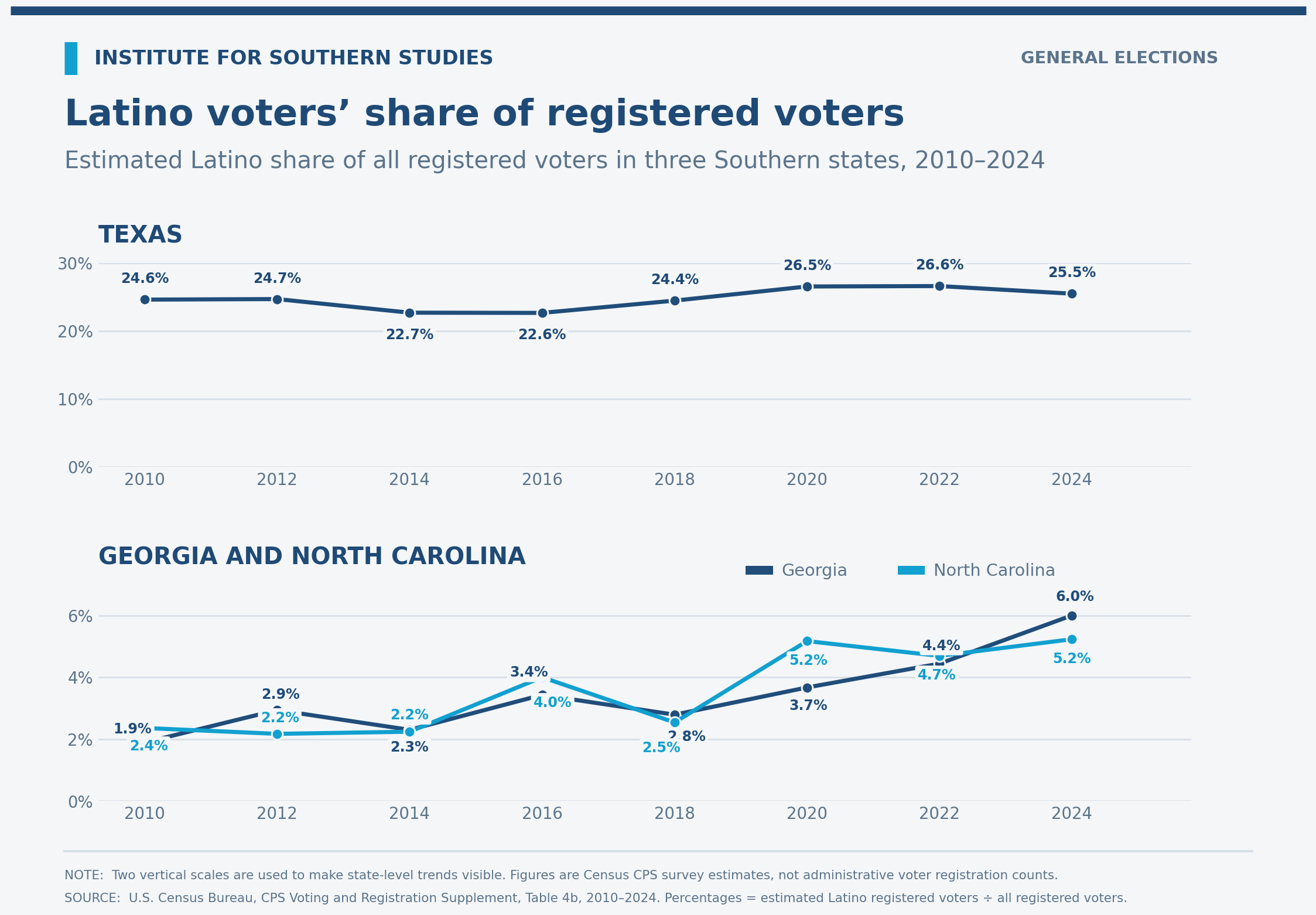
In recent years, the South’s increasing Latino population has translated into a growing political presence. U.S. Census data shows that Latino voters tripled their share of registered voters in Georgia, increasing from 1.9% in 2010 to 6% in 2024. In North Carolina, the Latino share of registered voters more than doubled, from 2.4% to 5.2%. In Texas, the state’s already-significant Latino share of registered voters has stayed about the same during that time period.
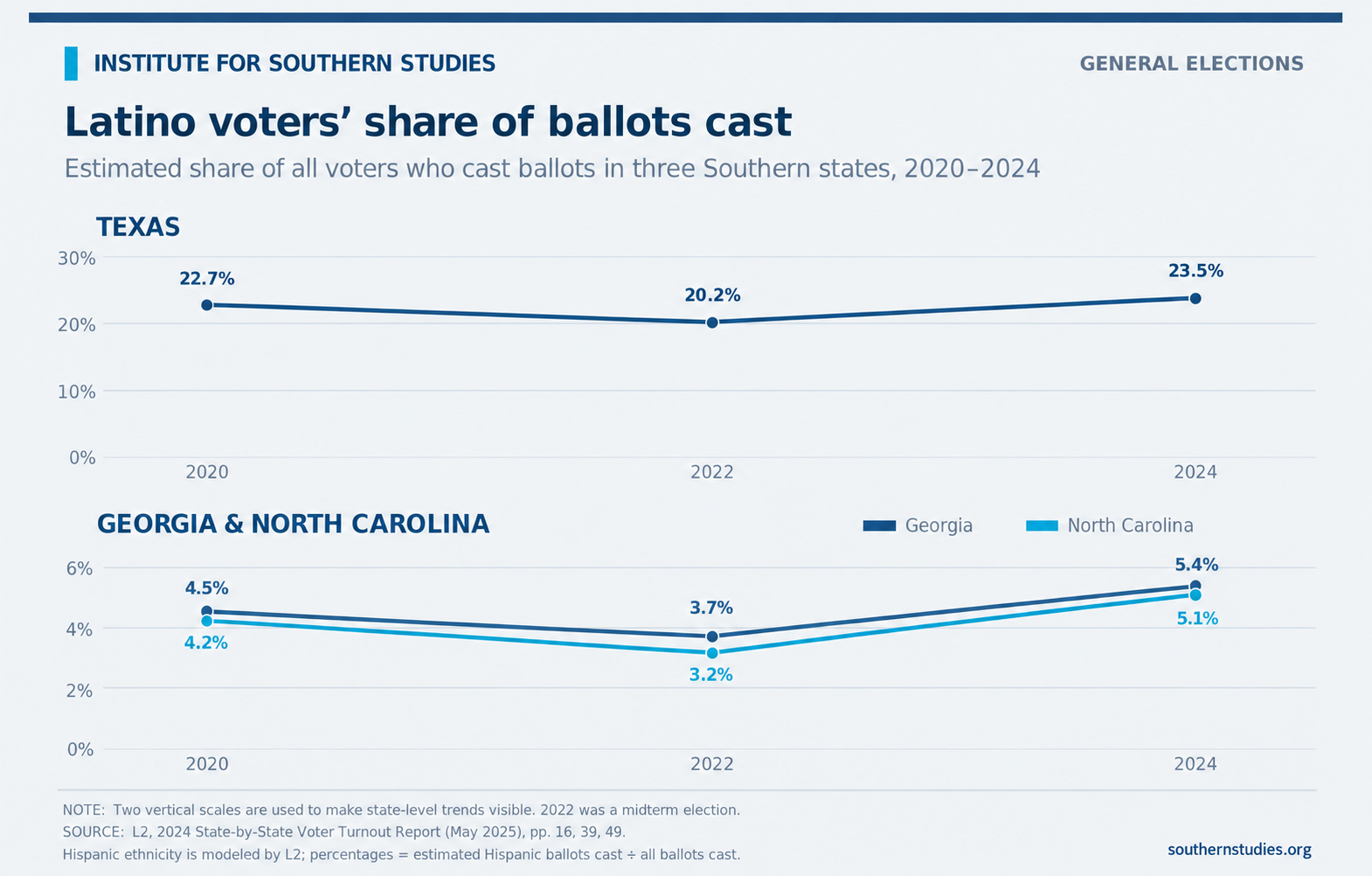
The growing Latino influence in these battleground states can also be seen in the share of ballots cast in recent elections. According to the voter data firm L2, which draws on troves of information to model Latino voter turnout, Latinos comprised 23.5% of the voting electorate in Texas in 2024, and more than 5% of voters in 2024 who cast ballots in Georgia and North Carolina.
Shifting attitudes, growing engagement in 2026
If a significant blue wave impacts Southern elections in 2026, Latino voters could be a leading factor. In 2018, Latino voters backed Democratic candidates over Republicans by a 47-point margin. The margin shrank to 21 points in 2022, and close to half of Latinos reported backing Trump in the 2024 elections.
Now, in 2026, Latino support for Republicans is in freefall. Here’s how the Pew Research Center summarized recent Latino polling data earlier this month:
Two years into the second Trump administration, the president’s standing with Latino voters has deteriorated. His current job approval rating among Latino voters, at 24%, is down from 38% in February 2025. And majorities of Latino voters say the Trump administration’s policies harm Hispanics more than help them and that their situation as a group is worse than a year ago.
Pew’s recent polls also found that the economy, healthcare, education, “the future of democracy,” and immigration were the top five issues of concern for Latino voters.
A recent New York Times/Siena poll similarly found that Latino voters favored Democrats over Republicans by a 30-point margin, a striking reversal from 2024, when Trump made substantial gains with Latino voters.
The Times found a 27-point swing towards Democrats on the issue of immigration alone, quoting a 42-year-old Houston engineer, Victor Torres, as saying: “The very inhumane way our current administration goes about immigration enforcement is terrible. People are being treated like hardened criminals, when they hadn’t done anything actually wrong while they’re here.”
Turning enthusiasm into votes
So far, it seems like Latino concern about the direction of the country is translating into votes.
This week, Tom Bonier, a data analyst with the Democratic firm TargetSmart, wrote on his Substack: “Hispanic turnout is surging around the country … [T]he increases are happening almost literally everywhere; in 96% of counties across the country the Hispanic share of the early vote is larger than it was at this same point in 2022.”
Bonier further notes that the surge is being driven by younger Latinos, especially younger Latina women. “Somewhat incredibly,” Bonier reports, “in many states, younger Hispanic turnout has been exceeding presidential year turnout compared to the same point in the 2024 election.”
In Texas, for example, Bonier found that, as of October 24, Latino turnout of voters under the age of 30 was almost double the turnout in the same time frame in 2024.
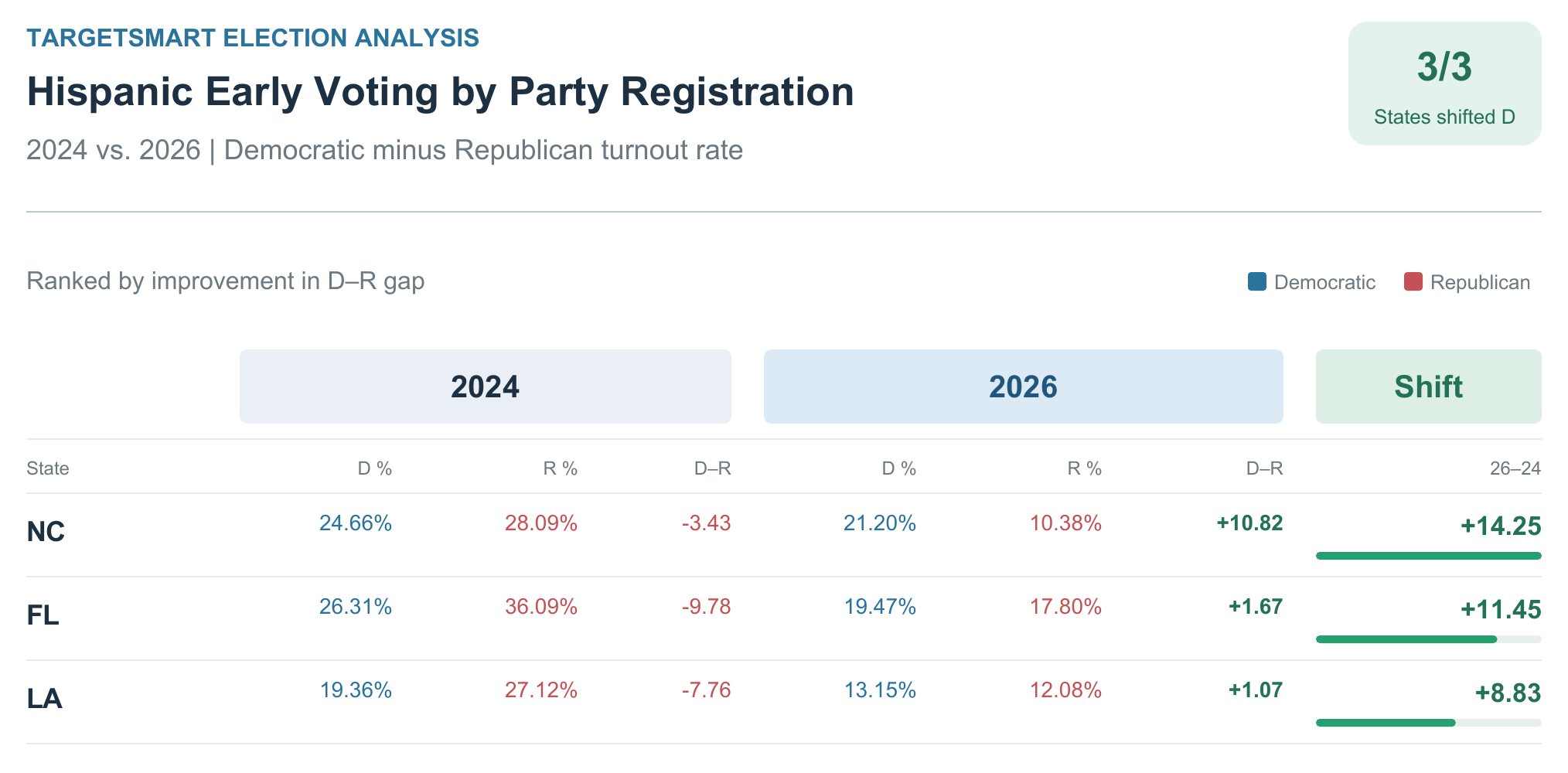
TargetSmart's analysis also points to a significant partisan divide in Latino early voting. In North Carolina, Florida, and Louisiana, Latino voters registered as Democrats have maintained much higher early-voting participation rates relative to Republicans than at the same point in 2024, suggesting greater enthusiasm among Democratic Latino voters.
Bonier is cautious to note that what’s happened so far in early voting doesn’t tell the whole story. Republican participation in early voting has increased in recent days, and many voters will be casting ballots on Election Day.
But the evidence so far suggests that the jump in Latino turnout in the South and nationally is driven by enthusiastic Democratic and Independent Latino voters, while Republican Latinos are “relatively demotivated.”
“At this point it is safe to say,” Bonier concludes, “That Hispanic voters, especially younger women, and Democrats overall, are highly engaged, and poised to make a difference in many key races.”
Tags

Chris Kromm
Chris Kromm is executive director of the Institute for Southern Studies and publisher of the Institute's online magazine, Facing South.