Questions linger about Whatley’s role in Helene recovery
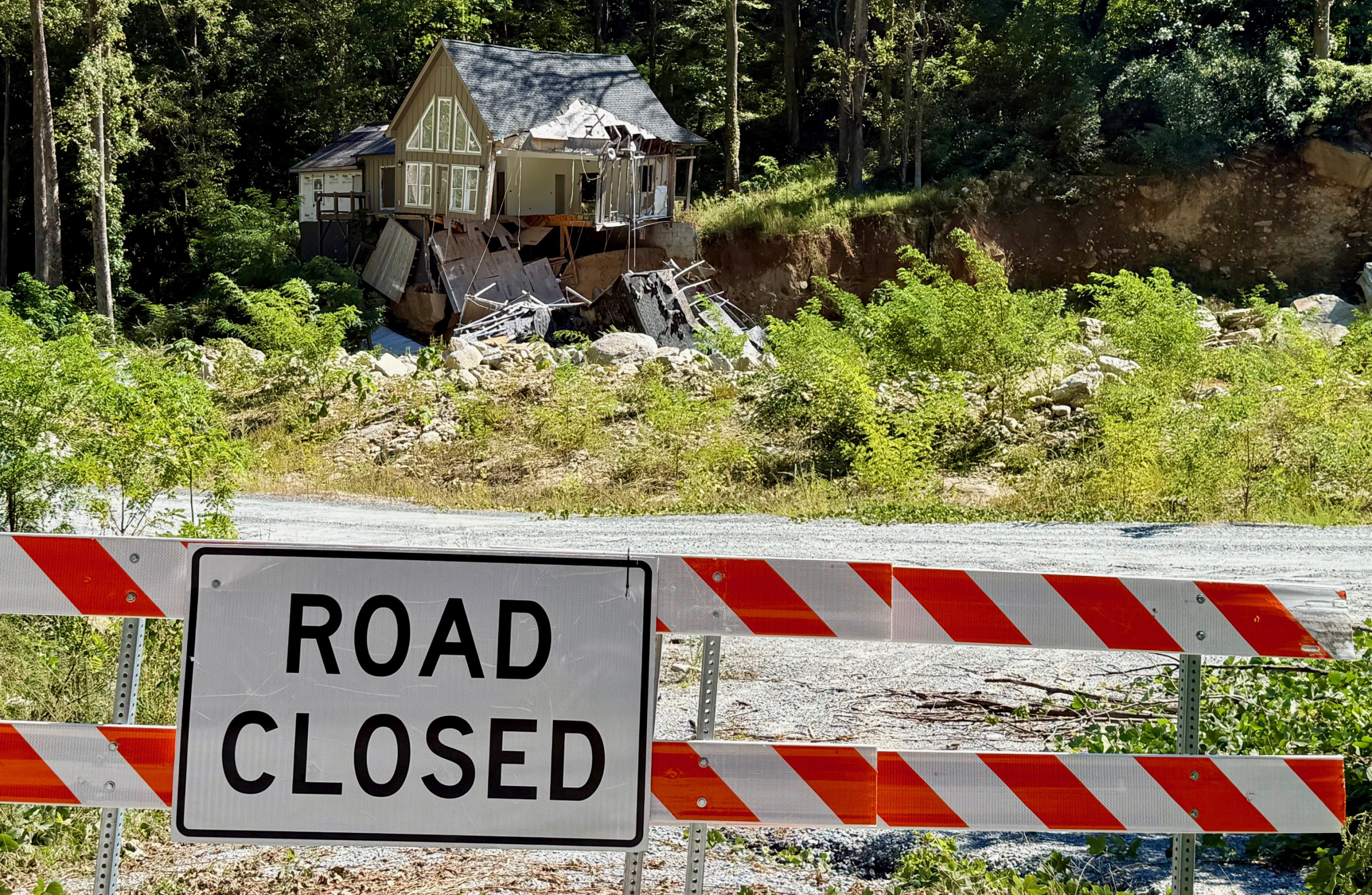
September 2026 photo of a house in Chimney Rock, North Carolina, damaged by Hurricane Helene, two years after the storm. (Photo: Chris Kromm/Facing South)
Hurricane Helene made landfall in Florida as a Category 4 hurricane on Sept. 26, 2024, before moving through southern Appalachia. In North Carolina, the storm damaged or destroyed more than 70,000 homes, took more than 100 lives, and left an estimated $60 billion in damage and recovery needs.
In a six-month investigation published Sept. 10, 2026, Facing South and The Nation found billions of dollars in unmet recovery needs in western North Carolina and a federal response weakened by turmoil at the Federal Emergency Management Agency (FEMA) during President Donald Trump’s second term.
The investigation also examined the role of Michael Whatley, the Republican U.S. Senate nominee in North Carolina, who Trump said in January 2025 would be “very much in charge” of the Helene recovery. All four western North Carolina mayors we interviewed said Whatley had not contacted them about Helene. Of the 17 hard-hit counties we contacted with public records requests about Whatley’s role in Helene recovery from Jan. 1, 2025, to June 30, 2026, 14 responded by the time our investigation was published; 11 had no records of Whatley’s engagement.
Since the Facing South/The Nation investigation was published, Burke County has also responded, saying it has no records of Whatley reaching out to county officials about Helene during that time frame, bringing the totals to 15 responses and 12 counties reporting no records.
Following publication of our investigation, the Asheville Citizen Times reported on Sept. 25 that public records showed six texts from Whatley and five calls totaling 38 minutes with Sharon Decker, a senior adviser to the Governor’s Recovery Office for Western North Carolina, over roughly a year. The story also included public records searches which found no direct communications between Whatley and officials at FEMA, North Carolina Emergency Management, or the state Department of Commerce.
Scrutiny of FEMA and Whatley’s record fueled a fierce media debate around the Helene anniversary. Whatley defended his record, saying he helped deliver federal aid to the state; as Whatley’s spokesman told WRAL, “What the feds have done in this case is already fund more than $11 billion, which is more for North Carolina than any previous hurricane, and those funds are continuing to flow.”
The basis for the Whatley campaign’s $11 billion figure is unclear. WRAL reported in September that the governor’s recovery database listed federal funding at $9.8 billion. In our Sept. 10 investigation, a state official said the Whatley campaign’s estimate at the time, more than $10.75 billion, likely included $1.5 billion set aside for hazard mitigation; the amount and timing of those funds remained uncertain.
Even $11 billion would amount to only about 18 percent of North Carolina’s estimated $60 billion in damage and recovery needs. As Facing South and The Nation documented, federal aid covered 78 percent of the estimated $88 billion in damage from Hurricane Sandy in 2012, and 73 percent of costs after Hurricanes Katrina and Maria.
Federal aid has also been slow to reach North Carolina. A key obstacle was a rule imposed in June 2025 by then-Secretary Kristi Noem of the Department of Homeland Security (DHS), which oversees FEMA, requiring her approval for DHS spending over $100,000. A report by Democratic staff on the Senate Homeland Security and Governmental Affairs Committee found the policy had delayed more than 1,000 contracts, grants or disaster assistance awards as of September 2025. Ken Pagurek resigned as head of FEMA’s Urban Search and Rescue division in July 2025 after Noem’s office delayed call center responses and other relief after historic flooding in Texas, which killed more than 130 people.
Noem was fired on March 5, 2026, two days after a Senate hearing at which Sen. Thom Tillis, a North Carolina Republican, called her leadership “a disaster.”
Whatley, however, publicly praised Noem’s leadership. In September 2025, Whatley said Noem was “doing a great job” in handling the Helene recovery. Two months later, he posted on X: “Thank you, President Trump and @Sec_Noem, for your steadfast leadership and commitment to helping North Carolina communities rebuild after Hurricane Helene.”
It’s also unclear what role Whatley played in securing the federal funding that did eventually make its way to North Carolina. North Carolina Gov. Josh Stein has joined at least four bipartisan congressional delegations to Washington to seek more Helene aid and faster approvals, most recently in June 2026.
With Whatley’s involvement in the Helene recovery under fire, The Washington Reporter — a publication founded in 2024 by Republican operatives — posted a glowing story on Sept. 25 claiming Whatley was “instrumental” in delivering federal aid to North Carolina.
The article’s only detailed example of Whatley helping secure recovery funding came from Bill Lapsley, a Republican Henderson County commissioner. The Reporter wrote that Whatley had “lined up millions of dollars for Henderson County” and quoted Lapsley: “Michael got on the phone and told [the Department of Homeland Security] that on behalf of the president, we need to get this straightened out, not only for Henderson County, but for the others that are in the same shape … About five days later, I get a phone call from the assistant secretary, and she says ‘check your bank account.’ We checked our bank account, and they had wired us about 15 million bucks.”
Facing South contacted Henderson County officials about Lapsley’s account. The county provided details of a $15.2 million expedited request to FEMA for debris removal, submitted in November 2024, with funds arriving in February 2025. Separately, news reports and a federal announcement also describe funding approved for Henderson County in November 2025 to reimburse contractors for debris removal; news reports put the amount at $15.7 million, while FEMA announced $14.8 million.
As of publication, the county had not answered Facing South’s follow-up request asking which FEMA payment Lapsley was referring to, when he contacted Whatley, and what Whatley did to secure the money. An email to Commissioner Lapsley asking for clarification about which FEMA payment he was describing had also not been answered.
In July 2026, Facing South and The Nation submitted a public records request to Henderson County concerning Whatley’s interactions with county staff or officials about Helene recovery from Jan. 1, 2025, through June 30, 2026. The county’s response included no documentation of the phone conversation Lapsley described.
Henderson County was an odd choice as an example of Whatley’s success in delivering FEMA aid. In a November 2025 story published by Hendersonville Lightning, Henderson County officials described their growing frustration over FEMA’s failure to reimburse the county for $60 million in debris removal costs. The story quoted Lapsley himself at an Oct. 21 meeting of the Local Government Committee for Cooperative Action: “Disgusted is putting it lightly with how not only we’re being treated, but the people in Western North Carolina,” Lapsley said. “And I don’t know if it’s politics, I don’t know if it’s ineptness on the part of federal staff. I don’t know, I don’t have an answer and I’m very upset.”
At the October meeting, Lapsley listed officials he had approached for help, without mentioning Whatley. “We have talked with Congressman Edwards, we’ve talked with our state representatives, we’ve talked with state staff,” Lapsley said. “Manager Mitchell and I have met with the FEMA representative over the whole region and expressed our displeasure with the situation.”
The same story reported that Henderson County Manager John Mitchell welcomed news that FEMA had obligated $15.7 million for debris removal. Mitchell credited two members of North Carolina’s congressional delegation — and also made no mention of Whatley. “Senator [Ted] Budd’s people had a lot to do with it. We also had direct involvement with [U.S. Rep.] Chuck Edwards,” Mitchell said.
Five months later, Henderson County was still struggling to get the FEMA support it needed. An April 9, 2026, USA TODAY Network/Reuters Connect story reported that Henderson County was nearly $27 million “in the hole” after spending $66 million on Helene recovery, much of it on debris removal. The story quoted Lapsley as saying, “Things have … not improved enough. This county is still, in my opinion, in a very bad place.”
Tags

Chris Kromm
Chris Kromm is executive director of the Institute for Southern Studies and publisher of the Institute's online magazine, Facing South.