'The South has something to teach': A conversation with LaTosha Brown
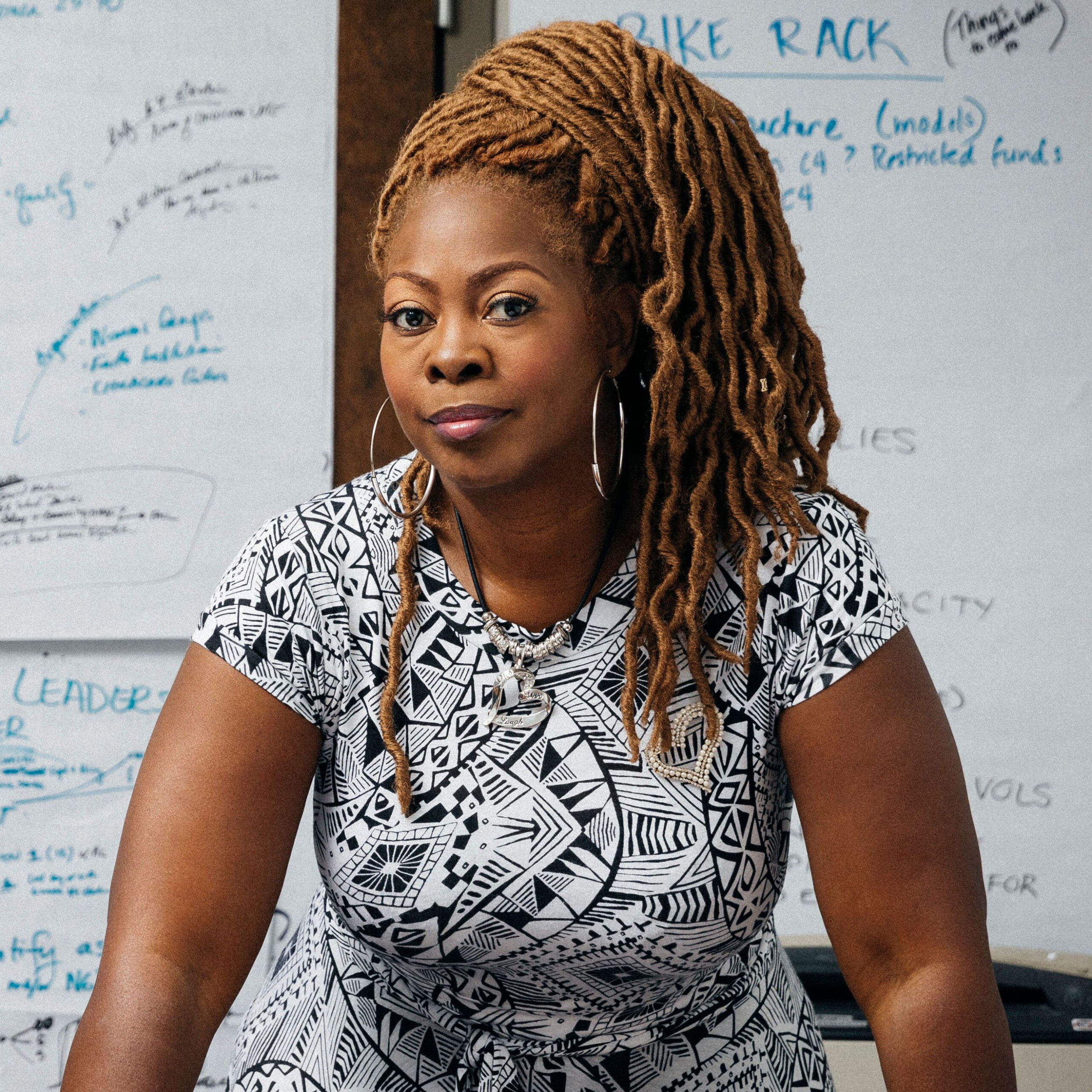
With Election Day less than a week away, voters across the South are casting early vote ballots in the 2026 midterm elections amid economic uncertainty, renewed battles over voting rights, and closely contested political races. Record-breaking early voting in Georgia and student-led marches to the polls in North Carolina have highlighted the political energy building across the region.
Facing South recently spoke with LaTosha Brown, co-founder of Black Voters Matter and a longtime Southern organizer, about the political mood in the region, efforts to combat voter suppression and disinformation, and why sustained grassroots organizing in the South is essential to changing the nation's political direction. A native of Selma, Alabama, Brown is now based in Atlanta. This interview has been condensed and edited for clarity.
* * *
The Black Voters Matter Fund has been working across the South ahead of this year’s midterm elections. What is the mood like on the ground in the communities where you’re organizing?
The South has something to say. People in the South are really on the front lines of feeling the economic squeeze that's happening right now. When you think about some of the challenges that farmers are facing, when you see some of the challenges resulting from the impact of this economy on our local states. In the state of Georgia, where I currently live, over a half a million people have lost their health care just in this year alone. When you think about the tariffs, the truth of the matter is we're absorbing that cost.
So all of that has created a particular kind of environment that we see as a different kind of energy in the South that is not driven by political parties necessarily. And not really driven just by candidates. And particularly when you look at not just the economic issue, but the political: The Callais decision, that has [exacerbated] gerrymandering of many of the Southern states, I actually think it is backfiring. People are responding.
What we saw in Georgia — first day of early voting, we saw the backlash. That backlash has led to the record-breaking turnout on the first day of early voting in Georgia. When you go to North Carolina, at North Carolina A&T, where they shut down a polling site, you saw hundreds of young people march forty minutes to get to the polls to vote. There's a particular kind of determination I think that has been set in place.
And so, one, I think when you think about the environment in the South, it is ripe where people are rising up and organizing themselves. Two, I think even the political and the economic conditions have also fed into that. And then three, I think we've seen there's some really good organizing.
When I think about where some of the best lessons and models of organizing are in the nation, many of those organizing models were developed and shaped in the South. So you have this perfect storm where you've got this organizing apparatus or infrastructure from social justice groups. You also have this motivated base of people, they are mad as hell.
So I think what you're gonna see is turnout all across the South. I think we're also seeing a rise in candidates where for years folks said that the South was solid red. I've often said that the South isn't red, the South is made up of people. And when people see solutions and we organize people, we can create a different outcome.
The South has a long history of voter suppression and voter intimidation. Can you talk about how Black Voters Matter is preparing to respond to election interference and intimidation?
If people think about what happened in Georgia earlier this year, where you had federal agents come in and take the voting [records] from 2020. Even though it has been certified and recertified and certified by both Republicans and Democrats. I always say that it is a spectrum of how it happens. One is to create this environment of doubt and fear. Two, to weaponize the federal government, to weaponize local police, to weaponize what seems like authentic institutions, to undermine and create this environment of doubt in the process.
And then the third thing is to create additional barriers. And that happens in a myriad of ways [including] misinformation, disinformation. There's disinformation circulating right now. I had someone ask me, "Is it true that if you have your ballot and someone writes on the ballot, your ballot is thrown out?" That's not true, right? But it's to create this frenzy of doubt and to undermine people's process.
And so what we are doing at Black Voters Matter is that we're organizing, meeting people where they are. We're turning this pain into purpose. We're turning this anger, this righteous anger, into action.
We've been building on these coalitions that have been working around the Callais decision, which could change the entire landscape of the South, particularly around Black representation. And so people are responding to that.
We've been having rallies, we've been talking to voters, we have been organizing. Every Tuesday, we have Texting Tuesdays, where we have hundreds of volunteers that join us, and they're reaching out to their friends, their family members, and even people they don't know to talk to them about this election and why it's important.
We've also been able to share information. We've had a couple of town halls, a couple of other events, and we make sure that we address some of the challenges in this election cycle.
We have joined forces with Indivisible and No Kings and others to push for people to vote early. We've got to make this election too big to rig, where the people come out in record numbers. And one way to do that is early voting.
We've also been creating this environment to offset the fear, this environment of excitement and joy. We had a voter rally at one of the largest precincts in Atlanta. We had voting rallies in Mississippi, in Texas, in North Carolina, and South Carolina.
And at the rally that I was at in Atlanta just recently, we had collards. We gave out over a thousand bunches of collard greens. We had food trucks, we had music, we had information tables to really be able to create this environment of community, because ultimately, we believe the best intervention is when the community sees ourselves as responsible for creating an environment where we feel safe and secure so that we can cast our ballot.
Black voters have historically been the backbone of progressive change in the South. Can you talk about the importance of Black voters in shaping the South and the nation?
I often say that we are the conscience of America. We are the original founders of democracy in this country.
It was one thing to put it on paper, but it wasn't real. At the same time that it was on paper, that all men were created equal, you had Africans who were enslaved, Africans who were stolen from their homeland. You had white people that didn't have land, that didn't have any rights.
What I think Black people have done in particular, we have continued to push and to force this nation to live up to its ideals. And so we have always been on the forefront of fighting for democracy, not just for ourselves, but in a way that expanded it for all Americans. The Voting Rights Act doesn't just protect Black Americans, it protects all Americans. And the attack on the Voting Rights Act does not just impact Black people, it impacts all Americans.
Sitting in a region that was structurally built on the vestiges of slavery, I think has given us an acute awareness of the need to resist authoritarianism. Why? Because we've actually lived under those conditions.
Trump may be a new phenomenon for many in the country. He is not for us. I've dealt with a Trump my entire adult life, whether it was him, or someone with that mindset, to lift up white supremacy and white nationalism and to try to take away rights and resources for communities.
I think Black voters have always been very sophisticated. Not necessarily because we're Black, it's because we've had to be. We've had to use voting as a tool of intervention to reduce harm happening to our communities. We've had to use voting as a tool to lift up our collective displeasure about things that have hurt or harmed us. And we've had to use voting as a tool to actually catapult leaders that we believe will fight for us and get the kind of policy changes that we need.
If you would talk to my family and ask them, are they progressives, they would never — my 92-year-old aunt would never say she's a progressive. She doesn't identify with that term. And in some ways, some of her beliefs would be considered conservative, within the political context. But when it comes to voting, we are very clear, that the oppression of any group — we understand the dangers of that, because we have actually been on the receiving end of that so much.
And so I think that Black people, I don't think that they think in terms of left or right or blue or red necessarily. We think in the terms of: Will this help us or will this hurt us?
Why is it important to invest in organizing in the South for the long term, rather than just during election season?
As we hear often, probably the most popular, famous phrase about the South is "As goes the South, so goes the nation," which I think was coined by W.E.B. Du Bois.
If you live in California, you live in New York, you live in Michigan right now, welcome to the South. You are actually seeing what it has been like to live in the South in many ways. We're seeing the abuse of power, we're seeing the level of corruption that is coming from inside of the house that is being protected by those under the guise and under the banner of white nationalism.
That is what we've had to deal with in the South. And part of what we've seen is that the South has had an enormous impact on shaping public policy for the nation, exporting and expanding white nationalism.
It is not by accident. I have to remind people, it's not by accident that Ronald Reagan kicked off his campaign in Philadelphia, Mississippi. The same thing with Donald Trump. If people remember, when Donald Trump ran the first time, where MAGA really was born was in Mobile, Alabama. What it’s saying is, I'm rooting my campaign in the South because I am going to exploit the power of white nationalism to build my agenda and to build my power base. Those of us in the South, we know those dog whistles.
What that means for us in this moment, what you can see is not just that the South has something to say, but the South has something to teach.
Many of the organizers in our region have been saying that, yes, policy is great, but policy without people does not work. Brown v. Board of Education was 1954. It wasn't until the early '70s that you start really seeing desegregation be addressed. We have always known that it's people power that can help stop this.
We've got a U.S. Senate seat in Texas that is highly competitive. We've got a U.S. Senate seat in Florida with a very open progressive, that not only beat the Democratic Party establishment, but is also head to head in a state that many had written off. Then we have a competitive seat in the state of Mississippi.
Something is changing. But part of that change has come from years of organizing work in the South, so that when the time and the opportunity presents itself, we could take advantage of that.
What do you want voters to understand about the importance of engaging and voting in this moment?
I want voters to understand that this is not just a regular election. This is an election about power. Who has the power to decide our future? Who has the power to decide who votes and who doesn't vote? Who has the power to decide who can benefit from the economics of this nation?
Because of that, I think it is important for us to see the election very differently. Instead of approaching the election as just a voter or as a citizen, we should be approaching this election as architects of a new nation.
I have three interventions I want people to think about in this moment: block, build, and believe.
Block. We need to block the harmful things that are happening right now. When we look at the hundreds of thousands of people who have lost health care access, when we look at the millions of people that are dealing with rising gas costs and rising costs for their homes — we have to use the election as an intervention to block harmful policies and to send a message that this is not the direction we want our nation to go.
But we also have to build. We can't just stand there. We've got to be more engaged in politics, not just in voting. We've got to show up to the meetings. We've got to show up at the Capitol. The people have to take our power back and show up in that way. So we've got to build and envision what it is that we want going forward.
And then the third thing is around belief. One of the biggest takeaway lessons from the civil rights movement and the voting rights movement in particular that I learned as a native of Selma, Alabama, is that these people did not have politics on their side. They didn't have a political party that they could depend on. They didn't have a lot of resources.
However, they believed that they could make change. They did not let themselves fall for the trick of cynicism to say, "It doesn't matter." They knew it mattered, because they mattered.
And so I'm hoping that as people approach this election cycle, we know that we can collectively create whatever it is that we want to create, but we've got to be the ones to do it. We are the ones we've been waiting for.
It will be through our organizing in the South and our changing of the South that we will in fact change the nation.
Tags
Benjamin Barber
Benjamin Barber is the democracy program coordinator at the Institute for Southern Studies.