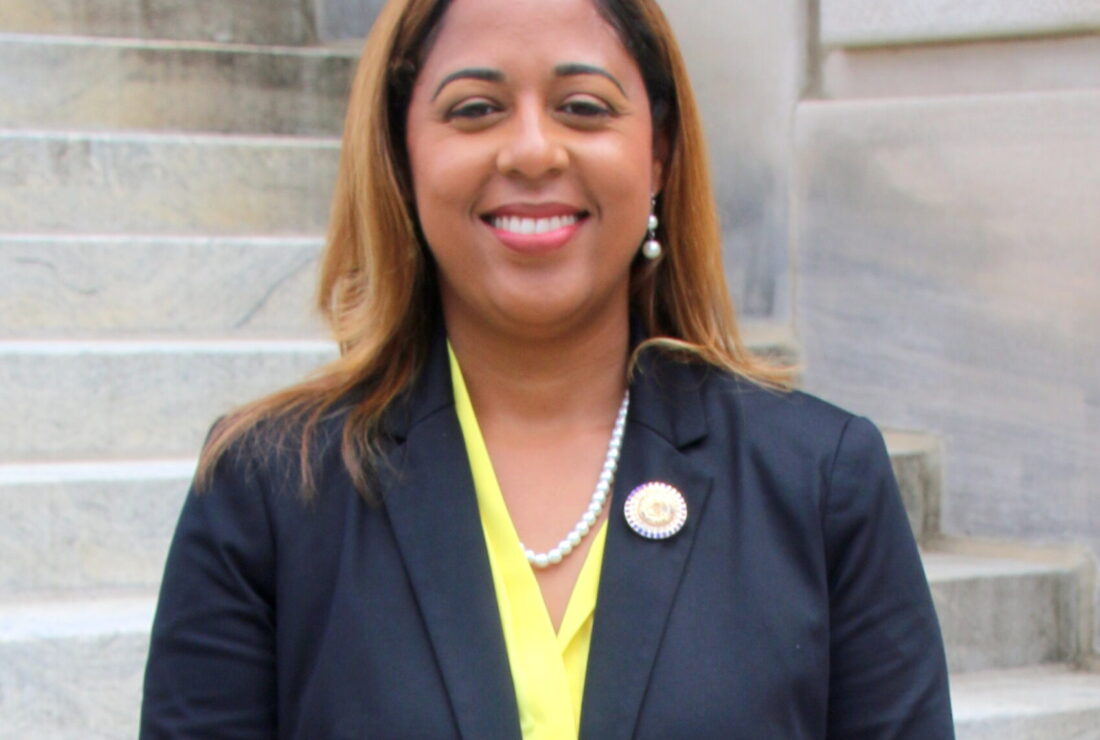
The Supreme Court is currently considering Louisiana v. Callais, a case that could further weaken the Voting Rights Act of 1965 and undermine representative elections in the South. In response, lawmakers are advancing measures at the state level aimed at protecting the right to vote for years to come. Facing South recently spoke with Mississippi State Representative Zakiya Summers, who co-sponsored the Robert G. Clark Jr. Voting Rights Act, a bill modeled after the federal Voting Rights Act. The proposal would have prohibited the dilution of minority voting power, created a Mississippi Voting Rights Commission, and required certain jurisdictions to obtain preclearance approval from the newly established commission before implementing changes to voting laws.
Similar efforts to establish state-level voting rights protections have emerged in other Southern states, including Virginia and Georgia, as advocates and lawmakers respond to the weakening of federal oversight. In North Carolina, voting rights advocates proposed a State Voting Rights Act in the Blueprint for a Stronger Democracy, a report coordinated by the Institute for Southern Studies — a nonprofit research and education center that publishes Facing South — and North Carolina For The People, a statewide pro-democracy coalition.
Although the Robert G. Clark Jr. Voting Rights Act ultimately died in committee, election officials and voting rights advocates say it lays important groundwork for pursuing more expansive voting rights legislation in the state. In our conversation, Summers discussed her experience advancing voting rights legislation, the importance of collaboration between election officials and voting rights organizations at the state level, and the urgent need for stronger protections ahead of this year’s midterm elections. The interview has been condensed and edited for clarity. A video of the full interview can be found on the Institute’s YouTube page here.
What inspired this effort to introduce the Robert G. Clark Jr. Voting Rights Act, and why was it important to push from the state level rather than wait on federal action?
We are anticipating a decision that will come from the Supreme Court on a case that's been brought out of Louisiana. What's at stake is a continued effort to gut the Federal Voting Rights Act by removing Section 2, which helps to protect Black voters from racial discrimination in election maps. And so, we know that the Supreme Court has been leaning very conservatively. We wanted to be proactive in our approach. We've been working with a coalition of civic engagement organizations primarily Fair Fight, [Mississippi] One Voice, and others to put forward the Robert G. Clark Jr. Voting Rights Act.
What this legislation would do is provide state-level protections as it relates to voting rights. We didn't want to continue to wait on the federal government to do what it needed to do to continue to protect those rights through the federal legislation. So, we wanted to have the ability to say that Mississippi will stand on the right side of history. We named it the Robert G. Clark Jr. Voting Rights Act because Robert G. Clark Jr. was the first African American elected to the Mississippi legislature after Reconstruction. We have not had an African American to win statewide office since Reconstruction. And when he came into the legislature, the first time that he voted, which was in 1967, he voted for himself.
Mississippi has a long history of voter suppression and passing laws that undermine voting rights. Can you talk about the significance of pushing this type of legislation in the state?
So, in 2013, we had the Shelby v. Holder decision that gutted the Voting Rights Act through Section 5. And following that decision, we began to see legislatures and secretaries of state push forward various tactics of voter suppression. Here in the state of Mississippi, right away, we implemented voter ID. And when we talk about voting rights, you can't leave out Mississippi. Mississippi has been at the forefront of the voting rights fight, you know, forever. I think about Freedom Summer of 1964 and the individuals that had so many sacrifices and really risked it all just for us to be able to participate in our political process.
And so it was befitting for Mississippi to come forward with this piece of legislation with the understanding of the prominent history that we've had as it relates to voting rights. Not having an African-American to win a statewide election speaks volumes to the fact that Mississippi has made it very difficult for people to vote. And so, we just wanted to make sure that we were doing our part to come forward with something that will provide those state level voting rights protections so that we can continue to protect our voters here in the great state of Mississippi.
Black voters are a crucial voting bloc in Mississippi and across the South but have not always been fully appreciated by the political establishment. What are some common misconceptions about the region's Black voters?
So Black Mississippians make up about 37%, 38% of the population. That's a huge block of voters that can determine the future of our state. And we see these pockets of strong Black population across the South. And we say, as Mississippi goes, so goes the rest of the nation. And as the South goes, so goes the rest of the nation because of the things that we've been able to fight for and put in place like the Civil Rights Act, like the Voting Rights Act that has not only helped to support Black representation in the South, but has actually helped all of the American electorate in making sure that they have unfettered access to the ballot box.
A lot of times we are discounted for the voting power that we have because we're able to elect the people that represent our best interests. And when we have those kinds of representation, particularly at the policymaking table, we see progressive legislation that not only helps Black folks but helps everybody. We're putting forward pieces of legislation that are rooted in justice and equity. And that's really what this bill is about. When we talk about state level voting rights protections, we're talking about everyone. So, we're talking about folks that may have English language issues. We're talking about disabled voters. We're talking about elderly voters, rural voters, and making sure that they're able to elect those folks that best represent them and can bring their concerns to the table.
Can you talk about the importance of collaboration between grassroots organizers and elected officials when pushing for more expansive state voting policies?
History teaches us that the gains that we have made have come from the bottom up. They've come from grassroots efforts. They've come from civic organizations, the NAACP, the ACLU that have worked to organize communities and get those communities to be involved in a tremendous call to action. And to help bring elected officials to task to address the issues that they're experiencing within their communities. And I think it's a win-win situation when you can have the community behind elected officials working along — I shouldn't say behind, I should actually say working alongside — elected officials, because then you're meeting the moment in a way where everyone benefits.
And so when we're able to go into community or go into our districts and talk with constituents about issues surrounding voting rights and we have the support of civic engagement, not only does it help to make the legislation stronger. It also helps to empower voters, so that they can help us in carrying the message, in gaining more support, in calling our colleagues across the aisle and help raise attention with them about the impacts of this legislation — and, more importantly, what we can do to ensure that the folks that we represent have equal access to the ballot box. The way that we make democracy strong in the state of Mississippi is by educating voters and by engaging them.
With a crucial midterm election fast-approaching and voting rights under increasing attack nationwide, what strategies or insights would you offer to state lawmakers or advocates working to protect our democracy across the South?
It's tough in this environment. We are battling against an administration that is really making life harder for everyday citizens and trying to do all that they can to roll back the rights and the gains that we've made over the last several decades. And then when you layer that with state legislatures that have Republican super majorities, it does become a little bit overwhelming.
But I just want to encourage legislators by saying that we're the ones that we've been waiting for. We're the ones in this moment in time, and we're going to have to be very clear, and there may be some sacrifices that we have to make, but it's on us now to begin to push back against measures that attempt to roll back time. Because what I'm very concerned about is that if we do not protect voting rights of Black voters, which are primarily throughout the South, and they're able to create an opportunity for a constitutional convention, because they only need 34 states to do it. We could be setting ourselves up for something that we’ve never seen before. We've got to be serious because the work that we're doing right now is necessary, not just for today, but for the future.
I'll tell you a really quick story. I never met my great grandmother. She lived in a very rural area of the state. And it wasn't until the Voting Rights Act of 1965 passed that she was able to vote. She would have to walk five miles in town to be able to vote. And along the way, she would tell her neighbors, which were acres away from where she lived, because she lived in a very rural area. And then she would walk five miles back home and she never missed an election. That was back in the 60s.
We think that that was ancient history. That was only about 60 years ago. But now, because of the fruits of her labor and the fruits of so many that have labored for years and risked it all, I have an opportunity to sit in a seat here at the state capitol that used to be run by people that said that we would never be able to hold these seats. Even when Mr. Clark came into the legislature, they were so upset that he had won his election that they sawed his desk in half and set him in the front so that nobody else would sit with him. And we even have that desk on the House chamber floor at this point in time. And so I just say all that to say that we have to remain persistent. We've got to stand together, unified — whatever personal issues we have with each other, we have to leave that at the door because what we're up against is an element that does not want us to have any kind of representation, that doesn't want us to have access to health care and access to education and access to voting so that we can have political power. And we know that our economic power is rooted in our political power.
Can you talk about the next steps to protect voting rights in Mississippi, and what your hopes are for the future of voting rights in the state and across the country?
Well, regrettably, this bill did meet its demise in committee. And to be totally transparent, we anticipated that because of the makeup of our legislature and the political atmosphere that we're in right now. Just recently, we disrupted the [Republican] super majority in the [Mississippi] Senate because of the Voting Rights Act. And so even though the bill has died, our desire and our work to continue to protect voting rights has not died and will not die. And we'll continue to use this as a tool and as a mechanism to raise awareness, to educate folks about what's happening, to help strengthen our efforts so that when we come back next session and we have more time to lobby it, hopefully we can see some movement on this particular piece of legislation.
And then my hope for the future of democracy in Mississippi and in this country is that we are able to continue to make it work. We have birthright citizenship in this country that gives us unfettered access to the ballot box. And yet we see efforts in Mississippi and across the country to continue to make it harder for people to vote. We've been dealing with disenfranchisement laws ever since the 1890 state constitution. And it seems like the closer we get to changing that, it becomes even more difficult for us to finally get it out of committee or even across the finish line at the end of the session.
Democracy is our form of government, but if we are not participating in it, if we are allowing the couch to take our vote, then we're not making democracy work. I would love to be able to see one day a woman become the president of the United States of America. I would love to see another person from a community of color to be able to hold the highest office. I would even love to see someone here in the state of Mississippi become the governor one day. That's how we continue to make democracy strong and we continue to make it work. And I don't believe that we are going to just allow the fabric of our democracy to be unraveled. And the way that we do that is that we participate, we become engaged, we work with our elected officials, folks like me and my colleagues that are within the Black Caucus to continue to press the needle forward. And we have to build pressure on the inside and on the outside.