South’s national political clout projected to grow after 2030 census
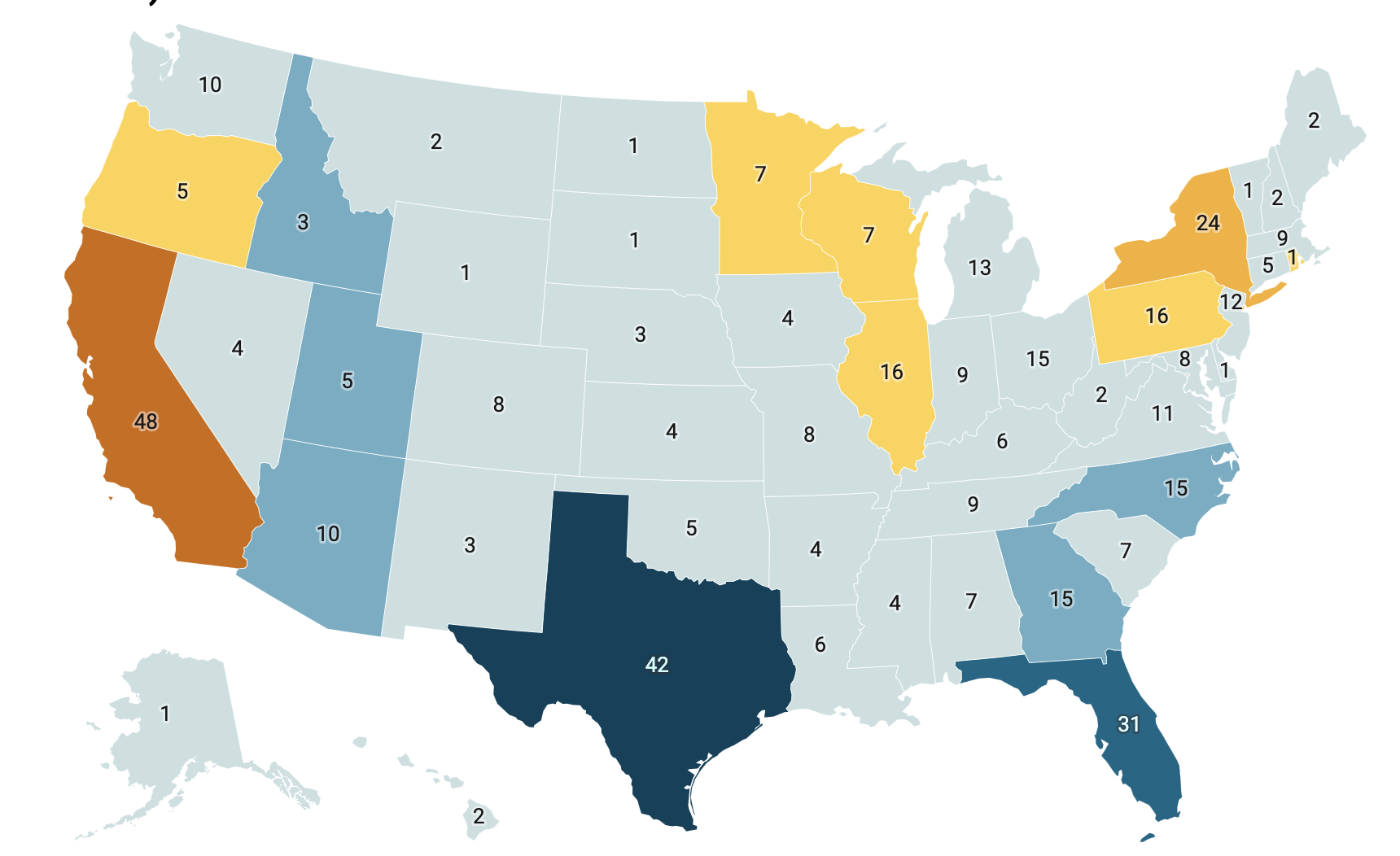
If Southern states continue to grow at the same pace that they have since 2020, the South’s national political influence could grow significantly when congressional seats are reapportioned after the 2030 census.
A new analysis of U.S. Census data by the Brennan Center finds that, based on population growth in the South between 2020-2025, Southern states could add up to nine congressional seats and the same number of Electoral College votes for president after the 2030 census numbers are tallied.
However, the Trump administration’s crackdown on immigration — a key driver of the South’s growth — as well as questions about the U.S. Census Bureau’s ability to accurately capture population data make projections of the region's political gains challenging.
The South’s growing clout
After the U.S. census count every 10 years, the number of U.S. House seats for each state is adjusted to match changes in population, a process called reapportionment. Every House seat gained also adds to each state’s number of Electoral College votes for electing the president.
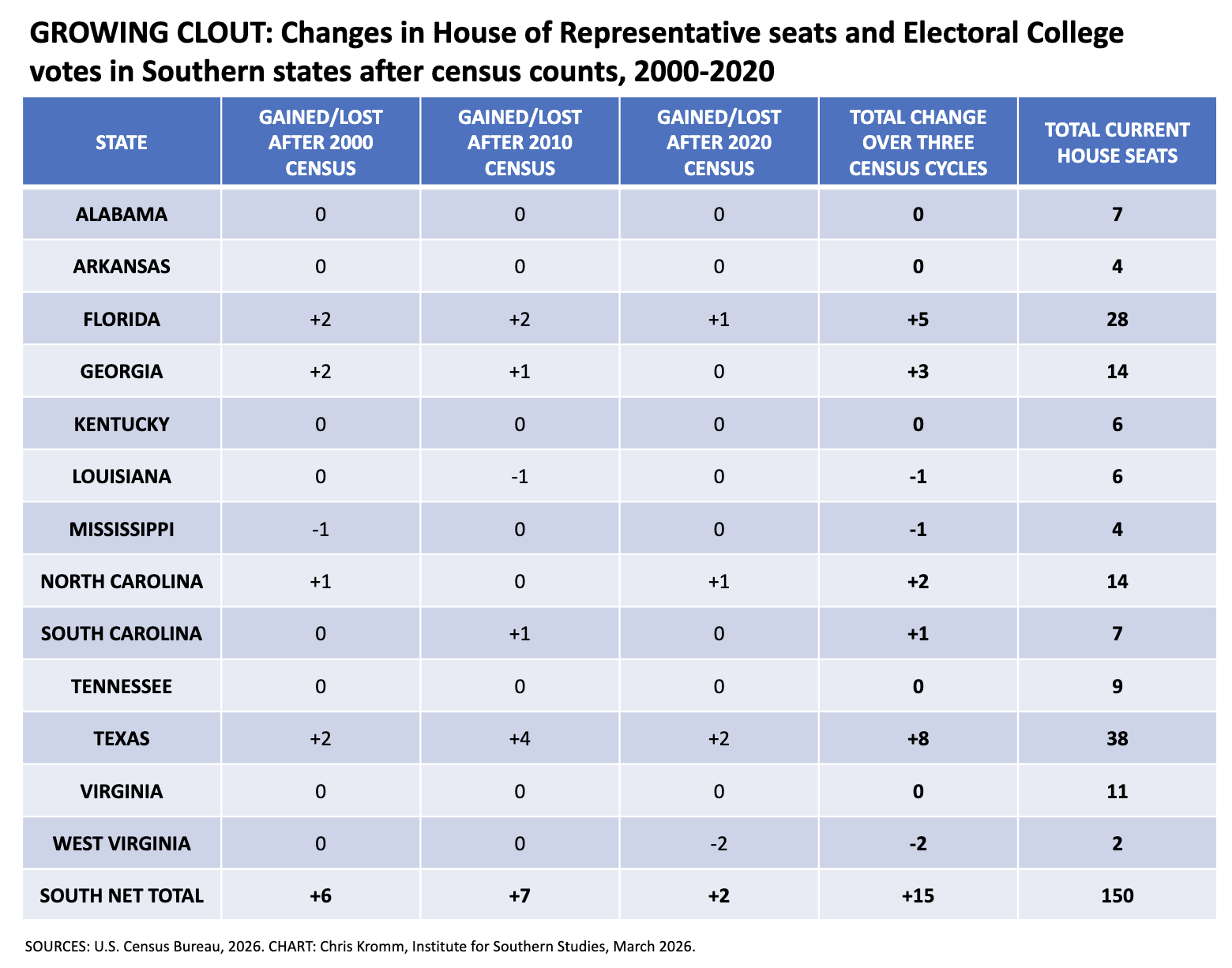
As the population of many Southern states has boomed in recent decades, the nation’s political gravity has steadily shifted to the South. Since the 2000 census, Southern states have seen a net gain of 15 House seats and Electoral College votes.
Florida and Texas account for 13 of those added seats, Georgia and North Carolina picked up a combined five seats, and South Carolina added one in that 20-year span. The South’s gains have been mildly tempered by small declines in Louisiana, Mississippi, and West Virginia, which together have lost four seats since 2000.
More projected growth in 2030 ...
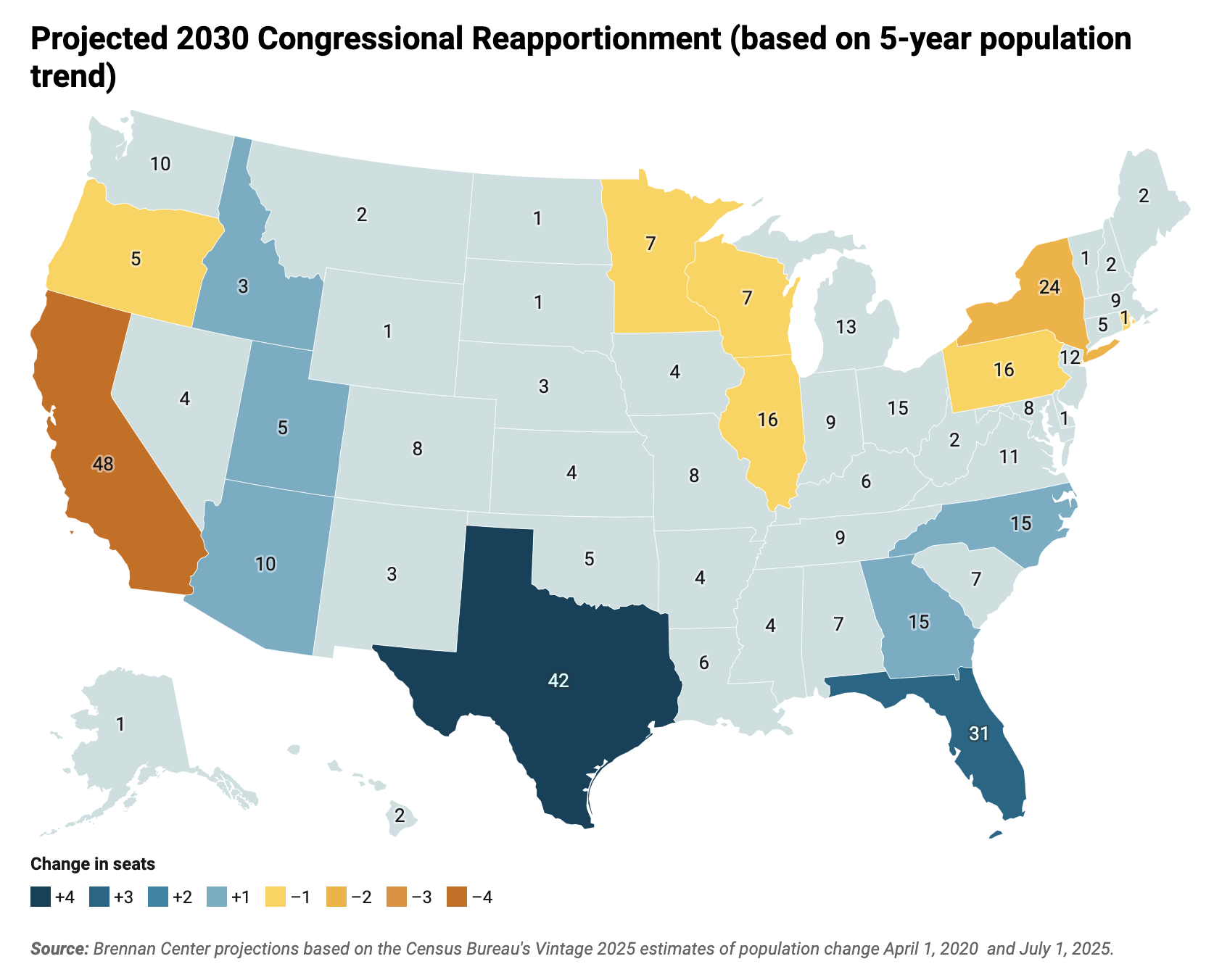
Drawing on population figures released by the U.S. Census Bureau in January, an analysis by Michael Li of the Brennan Center says that “new data suggests that the next reapportionment should, in theory, produce yet another blockbuster gain in congressional seats for the South – possibly the region’s biggest ever.”
Based on each state’s trajectory since 2020, Li’s analysis projects Texas to gain four seats, Florida to pick up three, and Georgia and North Carolina to add one seat each. No Southern states are projected to lose a seat, giving the South a projected nine-seat gain after the 2030 census is completed, and upping the region's total number of House seats to 159.
The South’s gains will come largely at the expense of the Northeast, the upper Midwest, and California; three Mountain West states could also gain up to three seats.
… but also more uncertainty
But as Li and others have noted, population trends for the coming years are especially difficult to project now, for a variety of reasons.
One is immigration. For most Southern states, their growing populations — and rising political clout — have been largely driven by newcomers from other countries. Immigration accounted for 44% of Texas’ growth and a striking 90% of Florida’s between 2024 and 2025. But immigration sharply dropped in 2025, in part due to the Trump administration’s aggressive initiatives to limit newcomers and deport those already in the country. The Census Bureau reported in January that immigration nationally was cut by more than half between 2024 and 2025.
Florida is also seeing a decline in in-migration from other parts of the U.S. In 2025, Atlas Van Lines’ latest Migration Patterns Study found that, for the second year in a row, Florida had a roughly even split between people moving into and out of the state. Moving has declined nationally in recent years — a trend that started with the pandemic — but the company noted Florida’s slowdown was especially pronounced due to rising housing costs, insurance premiums, and climate concerns.
Florida’s declining attractiveness as a migration destination is already affecting its projected political influence. The Brennan Center’s recent projection of Florida adding two House seats after the 2030 census is a decrease from estimates others made two years ago, when it was forecast that the state could gain up to four seats.
Census count trouble?
There’s also growing concern about how accurately the Census itself will be able to capture population figures in 2030, especially in Southern states.
The South has a high number of what census advocates call “hard-to-count” areas: places with a high share of historically undercounted populations such as renters, young children, people of color, and non-English speakers, as well as difficult to reach communities. In the Census Bureau’s postmortem of the 2020 count, five of the six states that the agency believes were undercounted were in the South: Arkansas, Florida, Mississippi, Tennessee, and Texas.
In January, the Census Bureau announced it would significantly reduce the scope of the field tests that will be run this year in preparation for the 2030 census. The tests are a trial run where the agency experiments with different approaches to boost census participation among hard-to-count populations.
Before the 2020 census, the first Trump administration also cut back on field tests, which demographers and advocates argue contributed to the undercounts. Changes for the 2026 tests include reducing the number of test sites from six to two, using a longer version of the survey that prioritizes a question related to U.S. citizenship, and replacing trained census enumerators with U.S. Postal Service employees.
“If implemented, the [census test] changes would undermine the utility of what should be a broad, multi-site rehearsal of census operations, potentially compromising the validity of the 2030 Census results,” wrote Haley Brown of the Center for Economic and Policy Research. “By sidelining historically underrepresented communities and weakening the integrity of the test, the Trump administration is treating the census as a means to consolidate political power through exclusion. Should these changes proceed, we risk a census that entrenches representational and resource disparities until at least 2040.”
Tags

Chris Kromm
Chris Kromm is executive director of the Institute for Southern Studies and publisher of the Institute's online magazine, Facing South.