Supreme Court sharpens divide between South's diverse communities and those who represent them

Black members of the Tennessee House of Representatives link arms in protest as Republicans pass new Congressional maps that eliminate a majority-Black district in Memphis and make an entirely GOP delegation likely. (Image: Tennessee House of Representatives video)
Last week, the Supreme Court handed down its much-anticipated ruling in Louisiana v. Callais, the landmark Voting Rights Act case. In a 6-3 decision, the conservative majority struck down Louisiana’s Congressional map, arguing that its inclusion of two majority-Black districts constituted unconstitutional “racial gerrymandering.”
The ruling was the latest in a series of conservative court attacks on the Voting Rights Act, beginning with Shelby County v. Holder in 2013. Voting rights advocates argue Louisiana v. Callais eviscerates Section 2 of the Act, which outlaws voting discrimination on the basis of race and has been used to create “opportunity districts” aimed at ensuring communities of color would have Congressional representation.
Perhaps ironically, the Supreme Court’s ruling comes at a time when the South is becoming increasingly diverse, and much of the region’s heightened political clout nationally is due to growing communities of color. With conservative politicians in control of redistricting in every Southern state except Virginia, the court’s latest ruling threatens to sharpen the divide between the growing Asian, Black, and Latine communities that make up the South, and the people who represent them in office.
The Changing South
Over the last two decades, the South has undergone a period of dramatic demographic change. The region’s racial makeup has become increasingly diverse, with growing Asian, Black, and Latine communities across the region.
Growing communities of color account for most of the population increases in Southern states, and — as the chart below shows — are the primary reason the South is the fastest-growing region in the country.
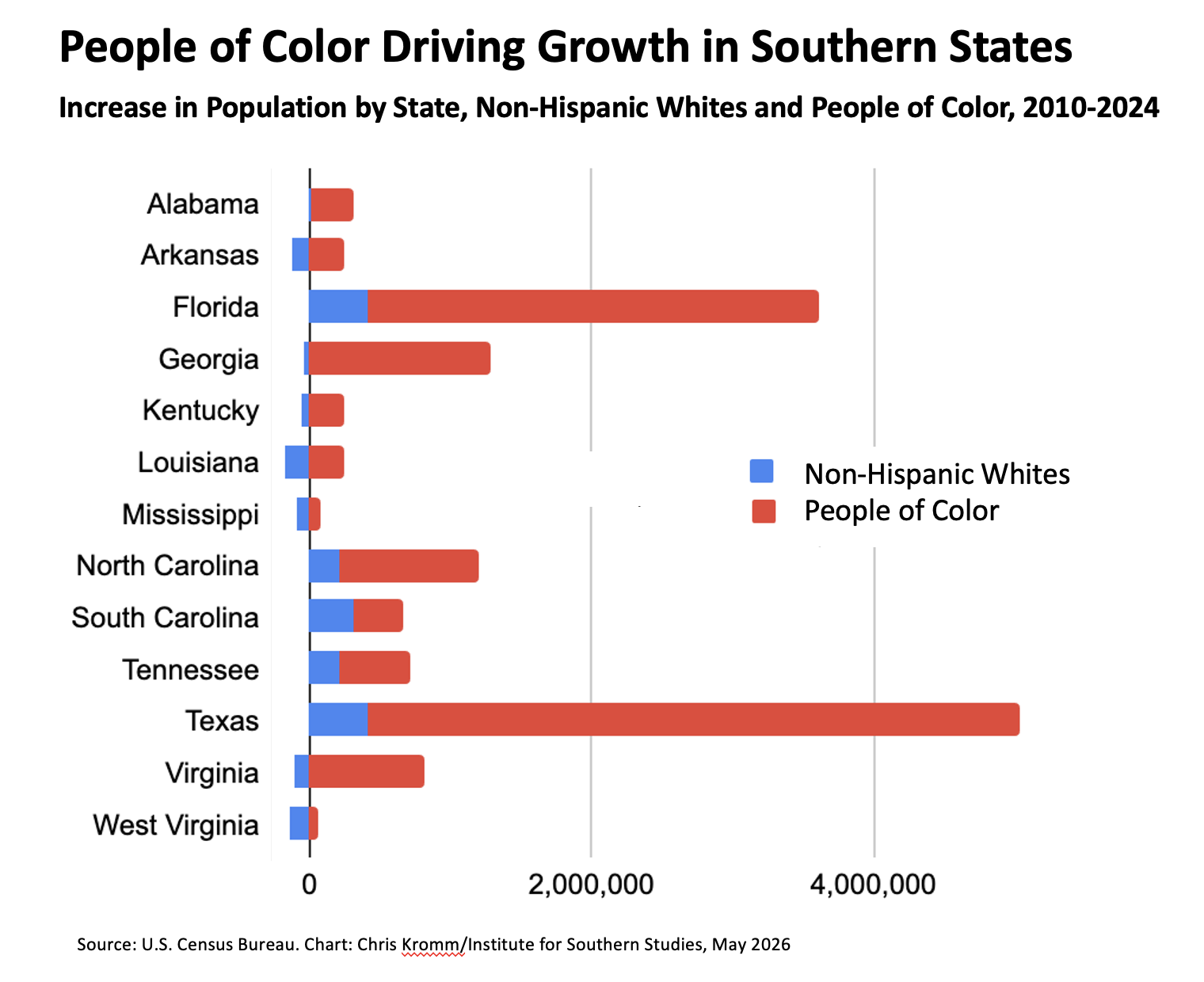
Indeed, it’s because of growth among people of color that the South’s political clout is increasing on a national scale. As covered earlier in Facing South, diverse growth in Florida, Georgia, North Carolina and Texas is projected to add up to nine new Congressional seats in the South after the 2030 census.
This has created an escalating divide between the South’s growing communities of color, which lean progressive, and Southern Republicans, who are using their control of the redistricting process to create more conservative districts in the region — districts that, in several Southern states, owe their very existence to growing communities of color.
Escalating the Redistricting Wars
There are already signs the Supreme Court’s recent decision will widen the disconnect between the South’s increasingly diverse communities and their political representation in the South.
Since its passage in 1965, the Voting Rights Act has been very successful in boosting representation of people of color in Southern politics, especially Black candidates. Now, amid a national redistricting war kicked off by Texas Republicans last summer, the Supreme Court’s Louisiana v. Callais decision has opened the floodgates for a new round of redrawn maps that will shift the South’s Congressional districts sharply to the right.
In Tennessee, Republicans released a new map this week that would split Memphis into three different Congressional districts and Nashville into five, giving the GOP an extra U.S. House seat. The Memphis district had been left whole in a previous round of Republican gerrymandering under Section 2’s protection of Black-majority districts; the three districts in and around Memphis that the GOP has proposed are all majority-white.
Alabama, which is under court order to refrain from redistricting until 2030, has petitioned to redraw their Congressional districts this year, citing the Louisiana v. Callais decision. The state currently has two Black-majority districts, which the Republican majority will likely now be able to eliminate.
This week, the Republican-led South Carolina House voted 87-25 along party lines to approve a redistricting session later this month; the Senate will vote on the measure soon. South Carolina currently has one majority-Black district, held by Rep. Jim Clyburn (D).
Mississippi had already planned to hold a redistricting session focused on state supreme court races. But after the Supreme Court's decision, Republicans are considering also redrawing the state's Congressional districts. The state has one majority-Black district, held by Democratic Rep. Bennie Thompson.
Georgia Gov. Brian Kemp (R) has said the state won’t redraw their lines in 2026, but that it may in 2028. The state currently has four majority-Black districts at risk due to the Louisiana v. Callais decision; Democrats also hold a majority-white district in Atlanta’s northwest suburbs.
By allowing Southern states to engage in more extreme gerrymanders, the results could be cataclysmic for Democrats in the South and the constituencies they represent.
Looking at current and planned GOP gerrymanders in eight Southern states, New York Times political analyst Nate Cohn lays out a scenario in which the number of Democratic seats could plummet from 24 to 13. In those eight Southern states, Cohn concludes: “Adding to the redraws they’ve already made since 2024, Republican-led states could eliminate most Democratic districts across the South.”
Tags

Chris Kromm
Chris Kromm is executive director of the Institute for Southern Studies and publisher of the Institute's online magazine, Facing South.