Southern Tsunami: Young voters fuel Democrats across the South, transforming political landscape

Democratic Senator-elect Scott Colom of Mississippi speaking at a victory rally on November 11, 2026. Colom was the first Black U.S. Senator to be elected in Mississippi since the Reconstruction era, and his victory was a defining moment in the Democrats' 2026 blue wave in the South. (Photo: Getty Images)
The 2026 elections may prove to be a watershed moment in Southern political history.
After nearly a generation of defeats and halting progress, Democrats made breakthroughs across the South this year, fueled by a surge in young voters, especially the region's Black and Latino electorate.
Democrats won six U.S. Senate races, flipping seats held by Republicans in Mississippi, North Carolina, South Carolina, and Texas. Despite aggressive Republican gerrymandering, Democrats also made big gains in the U.S. House. GOP lawmakers hoped that new political maps would net up to 15 seats, but Democrats ended up increasing their share of the South’s 150 Congressional districts from 44 to 55.
This year’s elections also saw a list of firsts in the South and country. Senator-elect Scott Colom became the first Black U.S. Senator elected in Mississippi since Reconstruction. Georgia’s incoming governor Keisha Lance Bottoms will be the first Black woman governor in the country. And Governor-elect Gina Hinojosa in Texas will be the state’s first Latine governor, ending more than three decades of Republican control of the governor’s office.
Receiving less attention was the blue wave that washed through down-ballot races, shaking up 15 years of Republican dominance in Southern state politics. After years of frustration and facing a host of obstacles — including a raft of voting restrictions and Republican-friendly political maps — Democrats gained ground in key state and local contests across the South, including state-wide races in Georgia and Texas, and added seats across the South in state legislatures.
Whether the Southern Democrats' 2026 victories were a one-time midterm backlash against a historically unpopular president, or the beginnings of a more long-term political realignment in the South, remains to be seen. In the meantime, Democratic wins have created new opportunities for promoting progressive policy, including reshaping how elections are carried out in key Southern states.
The Southern tsunami
How big was the blue tsunami in the South? In a year that saw one of the biggest partisan shifts in Congress in more than 50 years, Democrats scored wins in some of the South’s reddest areas, including states that just two years ago voted for President Trump by double-digit margins.
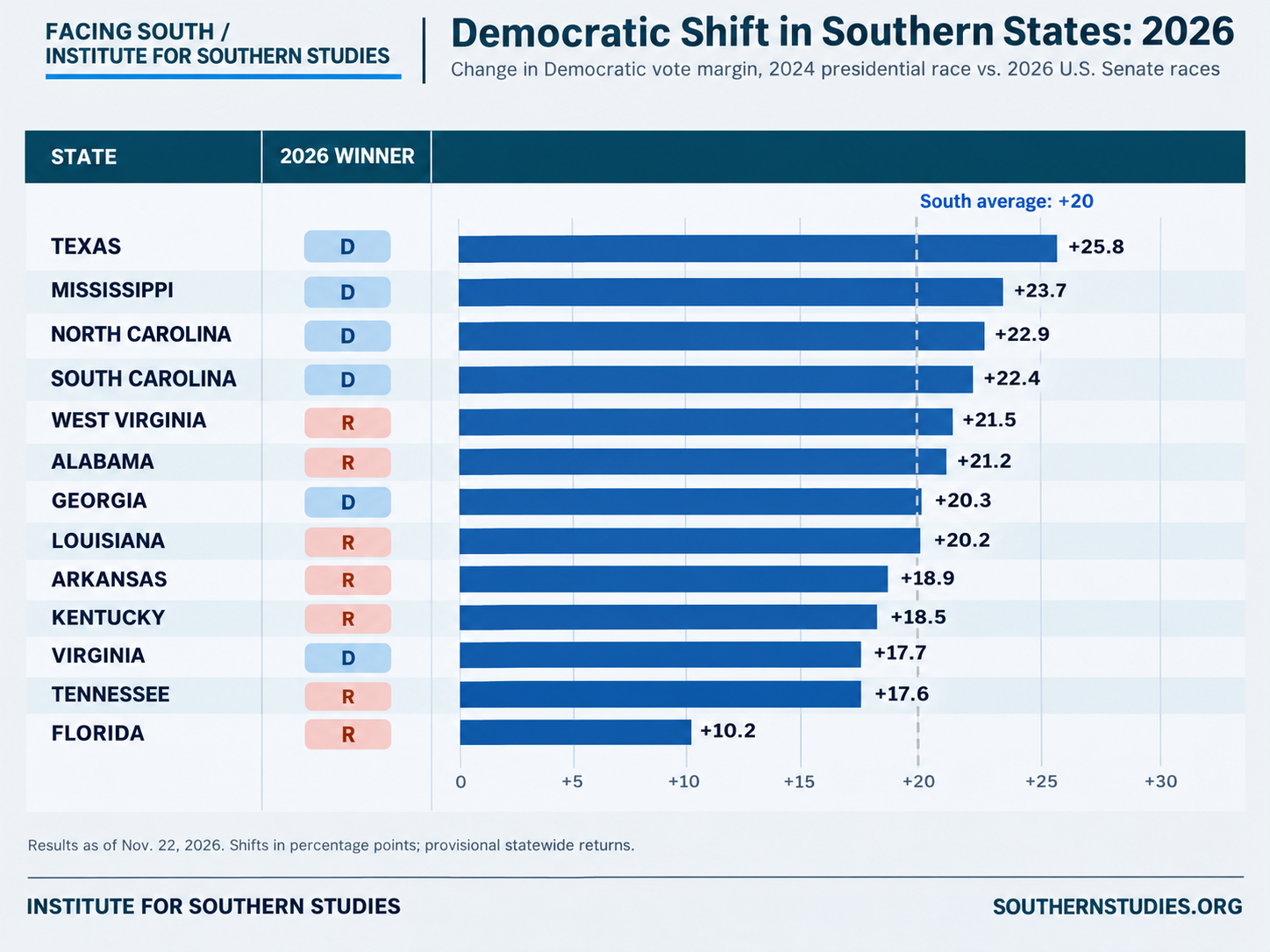
Take this year’s U.S. Senate races. In the South’s 13 Senate elections this year, the Democratic vote margin shifted an average of 20 percentage points in the party’s favor compared to the 2024 presidential election — a year when President Trump won every Southern state except Virginia. Democrats won six of the 13 races in 2026, including victories in Mississippi (a state Trump carried by 22.9 points), South Carolina (Trump +17.8), and Texas (Trump +13.9).
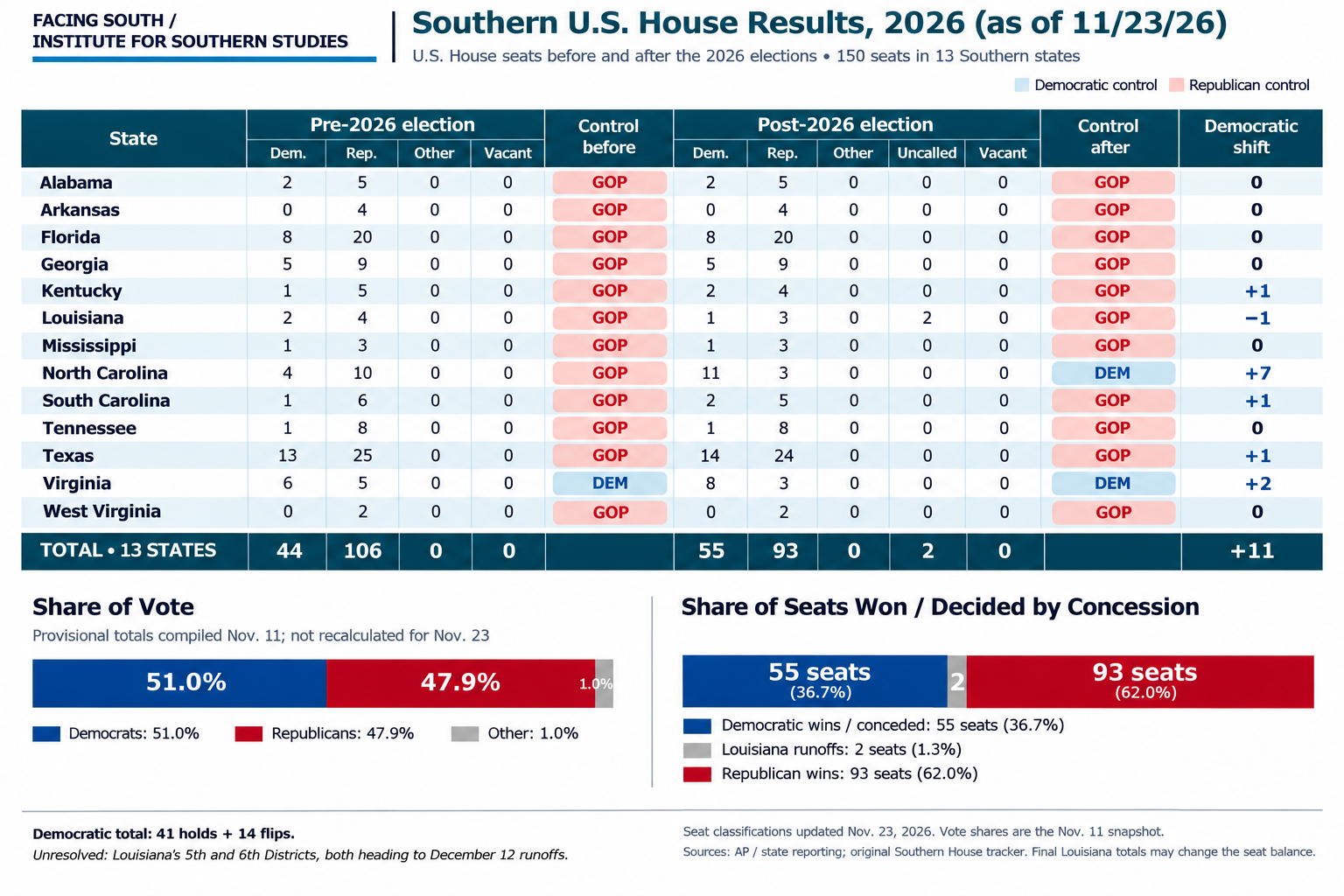
The U.S. House elections tell a similar story. Despite political maps favorable to the GOP — including six Southern states where Republicans passed aggressive mid-decade gerrymanders — Democrats have picked up 11 seats so far (Republicans are favored in two Louisiana runoff elections that will be held December 12).
Many pundits have taken the Democrats’ 2026 Congressional wins as evidence that the GOP’s redistricting push had failed or backfired. In reality, this year’s results underscore the enduring power of gerrymandering to skew election outcomes.
Based on preliminary vote totals, a Facing South/Institute analysis of voting data shows that Democrats won 51% of all Southern votes cast in U.S. House races — but won less than 37% of the contests. While Democrats will enter Congress in 2027 with at least 55 seats, if the South’s U.S. House seats were distributed proportionally to how voters cast their ballots, the number would be closer to 77.
The New York Times ran a computer simulation to divine how Republican gerrymandering impacted the 2026 U.S. House races. “In a hypothetical world without gerrymandering,” the analysts argue, “Democrats would have won many more seats in the big red states with successful Republican gerrymanders — Texas, Florida, Georgia and Tennessee,” as well as other seats.
Altogether, their analysis finds Democrats would have gained another 20 U.S. House seats in the South without gerrymandered districts. They note the one exception may have been North Carolina, where Republicans redrew maps in 2025 with the goal of sending 11 Republicans to the U.S. House — including the 14th Congressional District seat specifically drawn for former Republican N.C. House Speaker Tim Moore. In the end, the opposite happened: North Carolina Democrats won a shocking 11 seats, including Moore’s district.
A surge in Black, Latino, Asian and young voters
Democrats were propelled across the South by a surge in Black, Latino, and young voters — and depressed turnout among the older white voters Republicans have counted on in previous elections.
Detailed voter data won’t be available in most states for several weeks, but what information we do have points to how the South’s changing demographics helped fuel the region’s blue wave.
The first sign of a big shift underway was early voting. Nationally, more than 66 million votes were cast before Election Day either through mail or early voting, including 23.5 million in the South. Early voters tend to skew towards engaged partisan voters, so they aren’t a reliable measure of the overall electorate — although it’s notable that in Georgia, North Carolina, and Texas, the blue wave early vote was so massive that Democratic candidates running for U.S. Senate would have won their races with the early vote alone even if no votes were cast on Election Day.
In North Carolina, Latino early voter turnout more than tripled from the 2022 midterms, Asian early voting increased 107%, and Black voter turnout increased 52%. Texas saw an 87% increase in Latino early voter turnout compared to 2022.
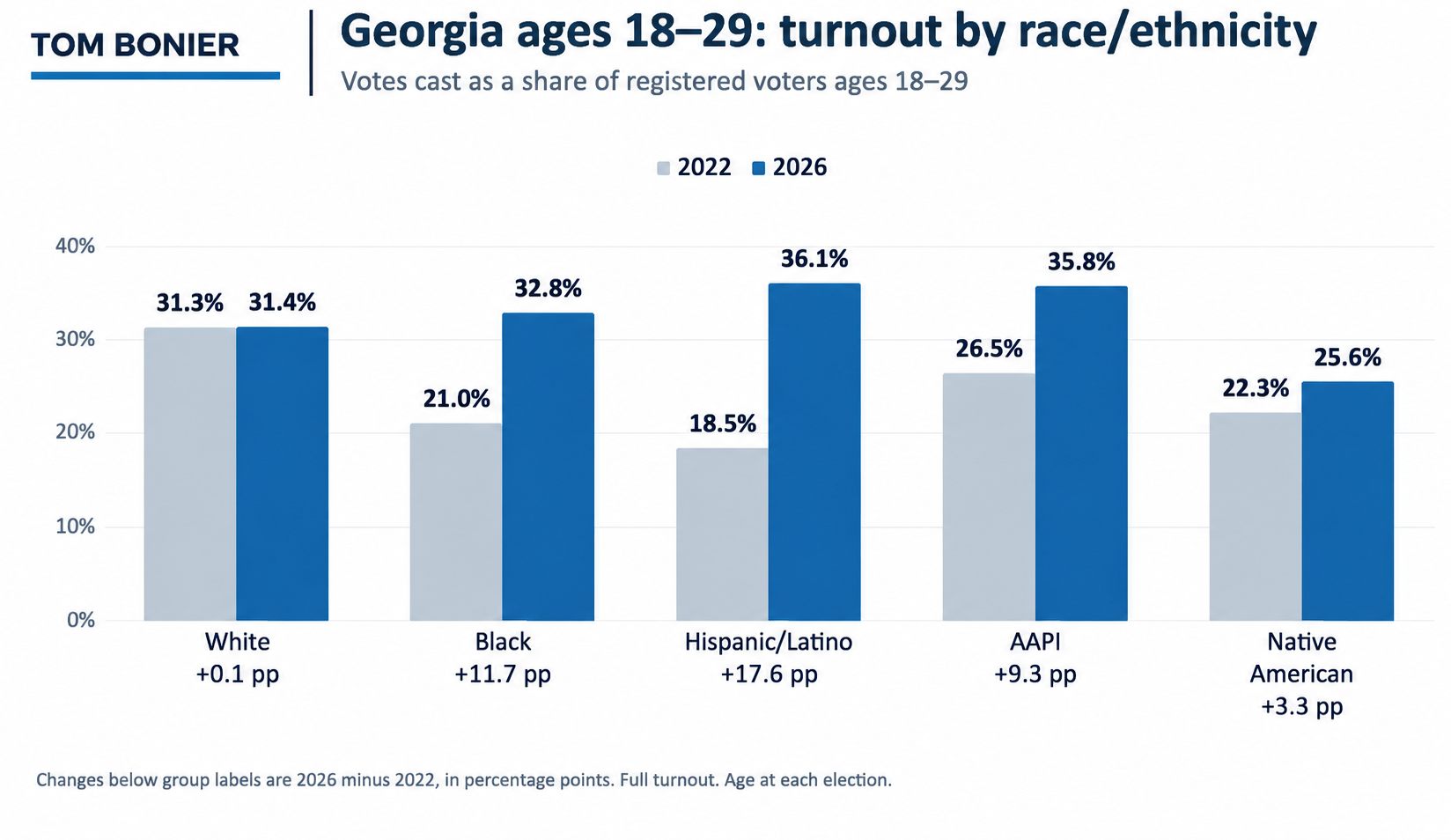
That enthusiasm appears to have carried through into Election Day. Looking at results in Georgia, one of the few states where detailed voter information is available, Democratic data analyst Tom Bonier explains the state’s blue wave as follows: “Voters of color and Gen Z turned out at a very high rate, while white Republican voters lagged in turnout.” Gen Z voters — those aged 18-29 — turned out at rates six percent higher than in 2022, and as Bonier notes, without this youth surge, Georgia’s overall turnout would have been below 2022 levels.
Across all Georgia age groups, voter turnout increased by 12 points among Latinos, eight points among Asian voters, and five points for Black voters; white voter turnout fell two points compared to 2022.
Another clue to the South’s electoral shifts can be seen by looking at votes at the county level. An NPR analysis of six Southern states found that turnout in majority-Black counties reached about 85% of 2024 levels, compared to 76% in majority-white, non-Hispanic counties. In fact, 16 majority-Black counties recorded more Democratic votes in 2026 than in 2024, a presidential election year; 12 of those were in Mississippi, where Senator-elect Colom won.
Numbers crunched by election data analysts G. Elliott Morris and Lenny Bronner also found that, in most Southern states, as the share of Black voters in a county increased, so did voter turnout.
Black voter turnout in the South was unique. “Outside the South, the surge in Black voter turnout disappears,” Morris notes. “There was no similar increase in the Black share of the electorate in Michigan, Illinois, or New York.” Morris attributes that to a reaction to the U.S. Supreme Court’s Callais decision, which eviscerated protections against racial gerrymandering, and other attacks on voting access and representation.
Political shifts in the states
While the Democratic gains in Congress have attracted the most attention, one of the most significant outcomes of the 2026 elections is that it shook up 15 years of Republican dominance in Southern state politics.
The GOP has commanded Southern state politics since 2010. That year, armed with record amounts of political spending and a midterm backlash against President Obama’s 2008 election, Republicans flipped control of the Alabama and North Carolina legislatures and strengthened their hand in others.
Aided by GOP-friendly legislative maps drawn after the 2010 census, the GOP steadily built on its advantage; by the time the dust had settled after the 2016 elections, Republicans held the majority in every Southern state legislative chamber — a position they’ve held in every state except Virginia, where Democrats won senate and house majorities in 2019.
Across most of the South, Republicans bolstered their GOP-friendly legislative district maps after 2020. At the same time, the legal basis for challenging racial and partisan gerrymandering was steadily chipped away by the U.S. Supreme Court, and Republican state legislatures also passed a slew of new voting restrictions, including more stringent voter ID requirements, limits on voter registration drives and mail voting, and cuts to local elections — measures known to disproportionately impact Black, Latino, and other voters.
The 2026 blue wave that crashed through the South broke or weakened the GOP’s hold on state politics across the region.
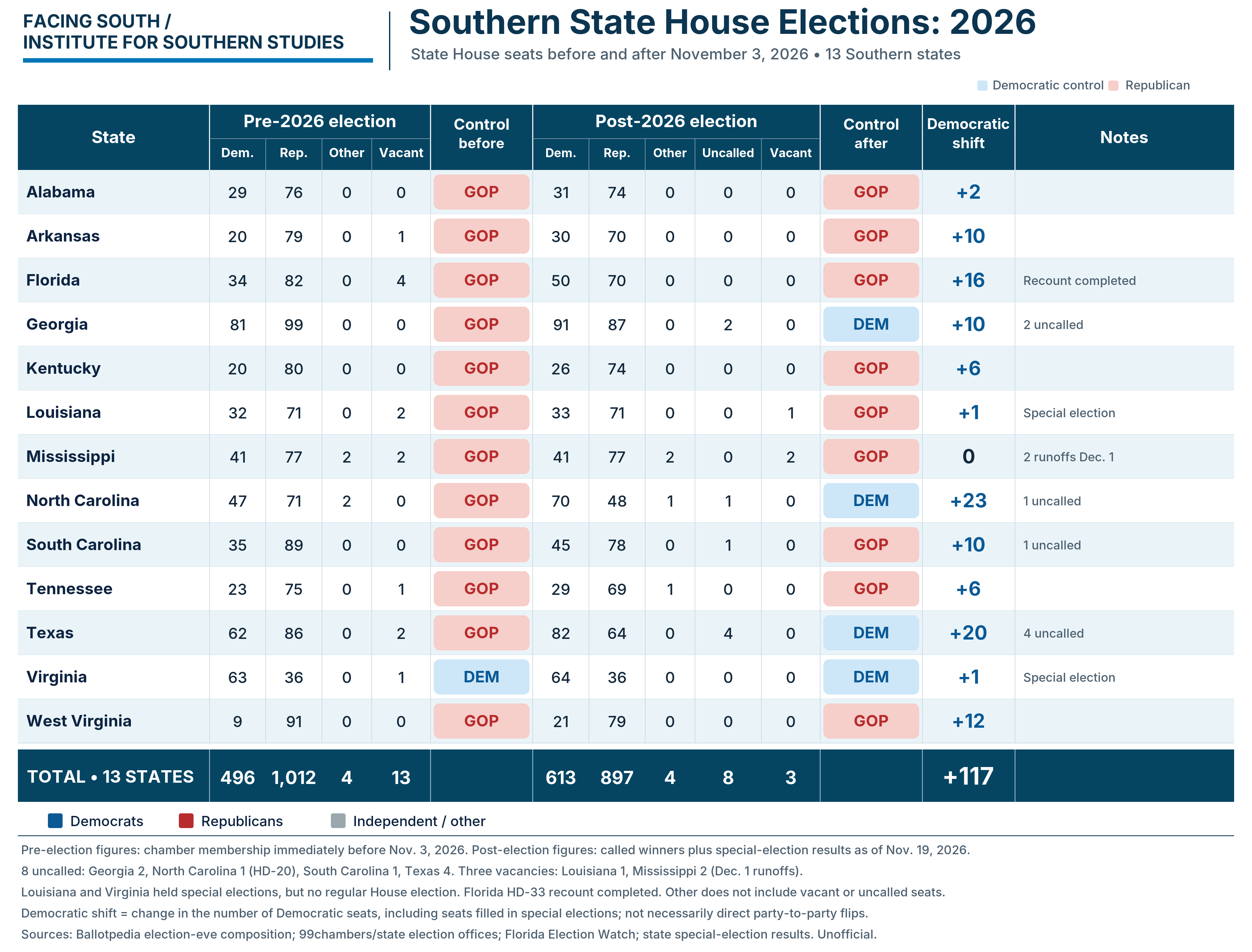
In the South’s state legislatures, in 2026 Democrats gained 117 seats in state house chambers, and 19 in the region’s state senates, for a total gain of 134 seats, with a handful of races still being decided.
The Democrats’ wins in the South were most significant in house chambers. Democrats were able to gain 10 seats or more in seven Southern states, and 20 or more in North Carolina and Texas. In Georgia, North Carolina, and Texas, Democrats emerged from the elections with a majority in their state houses, joining Virginia — which didn’t have regular elections this year — to make four Southern states with Democratic house majorities.
Democrats also made gains in Southern state senates, but the gains were more modest. Democrats didn’t win control of any additional Senate chambers, although they came close to securing a tie in North Carolina: Republican Sen. Danny Britt won over Democrat Catina Hamm by a mere 225 votes.
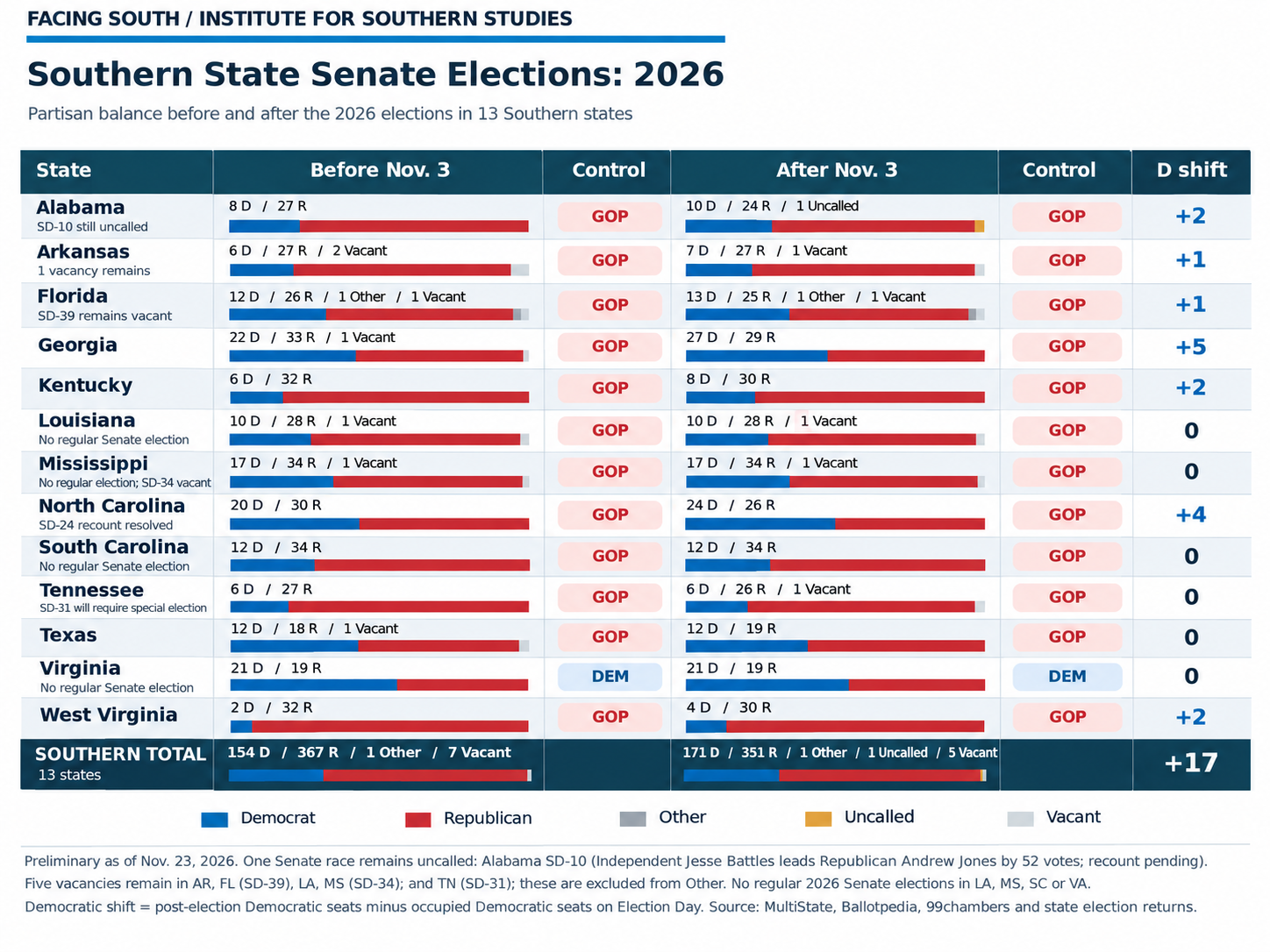
In Georgia and Texas, the Democrats’ legislative gains were complemented by wins in other key state offices. In Georgia, every statewide race was won by Democrats, including governor, lieutenant governor, attorney general, and secretary of state. In Texas, Democratic candidates similarly won a string of state races including governor, lieutenant governor, attorney general, and comptroller of public accounts.
State Supreme Court races were more of a mixed picture. Democrats defended the seat of Justice Anita Earls in North Carolina, and flipped four Texas state supreme court seats held by Republicans.
But in other states, including those which selected their justices earlier this year, Republicans prevailed, including Alabama, Arkansas, Florida, Georgia, Kentucky, Louisiana, Tennessee, and West Virginia. And Republicans still hold supreme court majorities in North Carolina and Texas, although Democrats are now within striking distance of flipping both courts in 2028.
How much of a difference will the Democrats' 2026 Southern tsunami make for politics in the region? On one level, Democrats' hands are still tied: Republicans still hold majorities in the state senates of Georgia, North Carolina, Texas, and control both chambers in every other Southern state except Virginia.
But wins in state offices in Georgia and Texas open the door for policy change in several key areas. In both Georgia and Texas, Democrats plan to push for Medicaid expansion, which has enjoyed bipartisan support in many states. In Georgia, Republican health policy advisor Ryan Loke said, “I’m fully confident that the General Assembly is going to expand Medicaid in the 2027 session. Like, 100% confident.” But these efforts could be hampered by the Medicaid cuts and restrictions in President Donald Trump’s One Big, Beautiful Bill.
Another key area is school funding. In Texas, Gov.-elect Gina Hinojosa campaigned on ending the state's controversial private school voucher program, passed in 2025. The program has been opposed by Democrats but also Republicans in rural areas, which have fewer private schools and have suffered from cuts to public school funding.
This year's political shifts could also bring changes to how elections are run. In Georgia, incoming Secretary of State Penny Brown Reynolds — the first Black person to hold the office — plans to propose changes to the state's Election Integrity Act, which included restrictions on absentee ballots and locations of ballot drop boxes, and increase election funding to rural areas. “Our 159 counties are not resourced at the same level and it is very very important that they have the tools that they need to be able to get people out to vote,” Reynolds said.
In Texas, Hinojosa is empowered to appoint the next Secretary of State, who will be in charge of the state's elections. Democrats are looking at election and voting reforms that could potentially win bipartisan support in the still-critical and GOP-led Texas State Senate, such as overhauling the state's voter registration system.
A lasting shift?
After years of being on the outside looking in, Democrats in the South seem to understand the conditions that swept them into office in 2026 were unique — and their gains in Southern politics could be fragile. Southern Democrats are emphasizing their need to deliver results. In rolling out her Georgia Promise agenda, incoming Gov. Keisha Lance Bottoms emphasized bringing jobs to the state, health care, funding schools, and improving government services.
But by making gains — and in many cases, winning — in the South, Democrats have strengthened their position for future contests. Aside from massive wave elections like we saw in 2026, incumbents generally do better in state elections due to advantages in fundraising and name recognition. By winning in 2026, Democrats have bolstered their ability to win again.
Perhaps more importantly, 2026 has shown what's possible in the South. With state elections slated for 2027 in Kentucky, Louisiana, and Mississippi — and the critical 2028 elections not far away — Democrats may have convinced national donors and strategists that wide areas of the South, once dismissed as impenetrable GOP strongholds, are in play.
New York Times columnist Jamelle Bouie argues that the 2026 results could change how Democrats and progressives think about the South, and what they can do even when there's no blue wave. As he recently wrote:
It is possible that these victories are a one-off, a highly contingent response to a ruinously unpopular president. One might even want to assume that this is the case. And yet it is difficult to overstate the extent of the opportunity here. Democrats have every reason to fully invest in the region and to abandon the pessimism, fatalism — and in some cases, chauvinism — that led the party to write off the Deep South as a truly lost cause. If Democrats take full advantage of the moment, they could build a durable coalition that is able to contest the region when the electoral environment is not as favorable.
Tags

Chris Kromm
Chris Kromm is executive director of the Institute for Southern Studies and publisher of the Institute's online magazine, Facing South.